DoHaeng Michael Kitchen

Human Created

January 19th, the NHL season will finally get underway.  I really don’t care.

This should concern me (and anyone who really knows me).  I marveled at the sport ever since the days of my youth.  And even though I’ve never had an athletic bone in my body, in gym class I excelled at floor hockey.

I wasn’t a casual viewer.  No, I was someone who…

  1. still has the program from the first hockey game I attended live (January 9, 1971, Detroit Red Wings vs Buffalo Sabres at the Olympia in Detroit).  Larry Brown is on the cover, and the Wings won 3-2;
  2. collected hockey cards from 1970 up through the late 1990’s;
  3. shared two season tickets to the Red Wings for three seasons (1989-90, 1990-91, and 1991-92);
  4. was the booster club president for the Detroit Jr. Red Wings of the OHL (currently known as the Plymouth Whalers) for two seasons (1992-93 and 1993-94);
  5. photographed the Detroit Vipers of the International Hockey League (IHL) and wrote a column in a local hockey publication for the 1996-97 and 1997-98 seasons (Great Lakes Hockey Alliance);
  6. traveled to places like Kalamazoo, MI; London & Niagara Falls & Owen Sound, Ontario; Montreal & Quebec City, Quebec; Long Beach, CA; Buffalo, NY; and Cincinnati, OH to watch live hockey;
  7. was the commissioner of a fantasy hockey league that spanned over a decade; and
  8. continues to wear vintage Detroit Vipers jackets appropriate for the season.

Why is this forty-year relationship coming to an end?  Perhaps the sport and I have just grown too far apart.

The first signs occurred after the IHL folded.  In 1994, the Detroit Vipers emerged at the Palace of Auburn Hills, which provided quality, entertaining and affordable hockey.  The IHL was a minor hockey league dating back to 1945.  With the NHL locking out its players during the 1994-95 season, the IHL expanded into areas to compete with NHL franchises.  Along with Detroit, the league added teams in Minnesota and Chicago.

I followed the Cincinnati Cyclones the year previous, as my sister and her family lived across the Ohio River in Kentucky.  But it didn’t take long for my blood to flow the aqua and eggplant of the Vipers.  I attended the team’s very first game (a 7-3 victory over the Cleveland Lumberjacks on September 30, 1994) and their very last game (a 3-2 victory over the Orlando Solar Bears on April 14, 2001) at the Palace.  I still have my photo passes for the June 15, 1997 game where they won the Turner Cup against the Long Beach Ice Dogs, and the October 3, 1997 game where Gordie Howe took to the ice for one shift as a Viper.  The memories are endless, and all of them fond.  The Vipers folded, and my passion for the sport waned.

Stan Drulia of the Detroit VipersPhoto by Michael Kitchen

Stan Drulia of the Detroit Vipers
Photo by Michael Kitchen

NHL ownership greed pushed me away.  Three lockouts which shortened this season and the 1994-95 campaign, and completely cancelled the 2004-05 season.  How does a tradition establish and maintain itself with this kind of off-ice instability?  Such gaps provide the opening for other interests to emerge.

The game itself went in another direction.  For each step forward that the league made, such as the elimination of the two-line pass, the game retreated a couple of steps because of the oppressive push to eliminate fighting from the game.  I’m not the biggest fan of fighting, but the role of the enforcer insured that players were held accountable for their brutal acts on the ice.  With that element removed, players have been able to injure each other with intent, and the league assuming punishments of suspensions and fines would provide adequate retribution.

The first game I attended back in 1971, no one wore a helmet.  In fact, the Buffalo goaltender, Joe Daley, didn’t wear a mask.  In those days, you didn’t have the concussions and injuries to superstars that you have in today’s game.  The addition of helmets and goalie masks are acceptable safety precautions.  However, it has lessened respect for each other on the ice, and the elimination of instant justice, coupled with the faster pace of the game has allowed for a more dangerous sport, especially for the marquee players.

Dissatisfied, frustrated, and watching the game grow away from me, a past lover returned in my life, which sparked what has become a renewed passion and rekindled love: soccer.

In 1978, I was introduced to professional soccer through the Detroit Express of the North American Soccer League (NASL).  It was their first year in the league and Trevor Francis made the experience magical.  Arriving after the first eleven games of the season (finishing his English season with Nottingham Forest), Francis destroyed opposing team’s defenses scoring 22 goals and 10 assists in 19 matches.  The first game I saw live was July 30, 1978 where the Express defeated the Fort Lauderdale Strikers (and legendary keeper Gordon Banks) 4-2.  Francis scored two goals and assisted on another.  I also attended the first round playoff match – a 1-0 victory over the Philadelphia Fury, with Francis netting the only goal.

8-21-2010_012

Trevor Francis triple-teamed by the California Surf.
Photo by Michael Kitchen

I got to a few more games at the Silverdome in 1979 and 1980, and watched as much of the NASL that was televised.  But then I was off to college and the Express and NASL went the way of other defunct professional sports leagues.

On June 28, 2000, while vacationing and visiting friends in Washington DC, I attended a DC United match.  The LA Galaxy beat DC United 2-1 that evening, but the love of the sport that had been in hibernation for 20 years was reborn.  A couple years later I got to my first Columbus Crew game, and since then, there’s been no turning back.

Eddie Gaven of the Crew dribbles through Stoke City of the English Premiere League.Photo by Michael Kitchen

Eddie Gaven of the Crew dribbles through Stoke City of the English Premiere League.
Photo by Michael Kitchen

The hockey cards I’m slowly selling off on eBay, and in place I have almost a complete collection of every MLS card set available.  I find myself able to watch, at most, a period of hockey, but I can lose two hours in the blink of an eye if Arsenal is on the telly.  I do miss going to Detroit Viper games, however neither the Plymouth Whalers or Detroit Red Wings motivate me to purchase a ticket.  But I’ll eagerly make the four-hour drive to Columbus for a Crew match.  Given the choice, I’d take a ticket to a Detroit City FC match and sit amongst the Northern Guard, Le Rouge Supporters and Motor City Supporters than an ice level seat amongst the suits at the Joe Louis Arena.

I could conclude that the death of hockey’s influence on my life is a part of a maturing process.  Other interests such as civic duties, promoting change and protesting the elements in society that promote a destructive status quo, immersing in my profession, and just trying to make the world a little bit better place then it was when I got here was prioritized higher than being entertained by sport.

Yet soccer has moved in and occupied hockey’s place in my life.  Perhaps that, too, is evident of a maturing process.  Hockey, despite what Gary Bettman tries to promote, is a regional sport, conducive to areas where winter’s breath creates the field of dream in backyards and ponds and streets of everyday life.  Soccer is global and its fans and players are a global community.  The sun never sets on the beautiful game, for I can follow Arsenal in the English Premiere League from August to May, and attend Columbus Crew matches from March through October.  And with matches played on a weekly, rather than three or more times a week basis, a two-hour soccer match once a week leaves time open for other, more noble and mature pursuits.

After forty years, both hockey and I have grown in different directions.  It was fun and formative.  But it is time to move on.

Detroit City FC thanks you for attending.Photo by Michael Kitchen

Detroit City FC thanks you for attending.
Photo by Michael Kitchen

On December 14, 2012,Adam Lanza helped himself to guns owned by his mother, to kill her and murder 20 children and 6 adults before taking his own life at Sandy Hook Elementary School in Newtown, CT.  This tragedy shook the nation, and even brought tears to the eyes of the President of the United States.  Since then, there has been talk, as well as the refusal to discuss, the issue of guns in the United States.  Also, concern about the treatment of mental illness has emerged as questions surround whether Adam Lanza suffered from autism.  Compound that with the video game burning to be held in Southington, CT., and the blame is well distributed.

Guns.  Mental Health.  Video Games & Movies.

Addressing these issues individually or collectively is merely focusing on symptoms of the deeper problem.

American gun enthusiasts throw out the cliché “Guns don’t kill people; people kill people,” as a mantra to protect their perceived rights to owning guns.[1]  However, they, and everyone else overlook the corollary:

Guns don’t protect people; people protect people.

This is the deeper issue.

We live in a society where our media, private interests, and politicians divide us based upon our differences:

Christians vs. Non-Christians.

North vs. South.

Conservatives vs Liberals

“Majority” vs Minorities

Male vs Female

Heterosexual vs LGBT

Pro-Life vs Pro-Choice

Rugged Individualism vs Collectivism

Free Market vs Socialism

Self-Made Man vs Welfare Queen

Workers who are anti-union vs unions

Corporate interests vs the environment

Wall Street vs Main Street

Profits vs People

Journalism vs Infotainment.

Liberty vs The Government

“Americans” vs. Immigrants.

United States vs All Other Nations.

Hammering these differences and creating fear against “the other” heightens our sense of self-preservation.  It is the promotion of this perpetual consciousness that allows us to witness the President of the United States with tear-filled eyes commenting on the Sandy Hook incident, yet fail to question why not  a single tear is shed, or even acknowledgment of the civilians and children he and his predecessor have killed in drone strikes in Pakistan, Yemen, and Somalia.

What kind of country are we that kills other country’s children (such as three children ages 12, 10, and 8) and justify it based on a philosophy that “In addition to looking for military-age males, it’s looking for children with potential hostile intent.”?

It’s okay to kill children who have “hostile intent?”  Really?

This corollary – Guns don’t protect people; people protect people – also relates to the mental illness discussion of the Sandy Hook incident.  In this nation, we are marketed the idea that a single-payer health care system, whereby we, as a collective people pool our resources into one central location – the government – to cover every one’s health care costs, is somehow inferior to the “pay-or-die” system we currently have in place.  The propagators of this idea are the very people who profit from the “pay-or-die” system – insurance companies, pharmaceuticals, private hospitals, and the media that reaps the financial benefits of these industries through advertising dollars.  Here again, our collective mantra is not “protect myself and all others,” but rather “me first, let everyone else take care of themselves,” which is the mental and societal breeding ground for incidents like Sandy Hook.

About three years ago I had a conversation with a couple – Dominic & Anna – who were Italian immigrants to Canada.  Health care was a hot button issue at the time, so I asked them about their experience with the Canadian system.  Anna’s mother had moved to the Metro Detroit area, and Anna had to care for her and her late father in the United States.  Anna could not believe the inhumane health care system that America has in comparison to Canada. She said that in Canada (and Western European countries like the UK, France, and Italy, where both Anna and Dominic were born), the common belief amongst its people is that we all look out for each other. “Over here,” she said, “it’s all about ‘me.’

Guns don’t protect people; people protect people.  The more we focus on that mantra versus the one the gun lobby and the citizens they’ve instilled fear into, the more sober an approach we’ll have to preventing incidents like Sandy Hook.  It’s not about arming every citizen (personally, if you need an assault rifle to kill Bambi, it’s time to take up a new hobby); it’s not about denying health care or maximizing profits from those who suffer from illness; or about burning video games (it’s seems an amnesty can be achieved without such a Fahrenheit 451 spectacle).  And if the President is concerned about the causes that are “desensitizing our children to acts of violence” as the Southington SOS claims in its press release regarding the video game burning, he should turn his attention to the largest perpetrator and influence of desensitized violence in our nation – the Pentagon.

Guns don’t kill people, nor do they protect people.  It’s about we, as a society, choosing how we wish to live.  If we’re going to be fear-based creatures, believing that everyone outside our immediate circle of family and friends is out to do us harm, whether they are in our neighborhood, city, state, country, or abroad, and therefore, we take care of our selfish interests first, and every other person for him or herself, there will be more tragedies similar to Sandy Hook.  However, if we become a society like those Dominic and Anna spoke of, where we all look out for each other, imagine what a different nation this would be.

Are we a people who kill people, or a people who protect people?

The choice is ours.


[1] I say “perceived” because, throughout the history of this nation, the Second Amendment has been interpreted to protect the “militia-related, not self-defense related interests.” (Justice Breyer’s dissenting opinion in District of Columbia v. Heller,128 S.CT, 2783 (2008)  Read Justice Stevens dissent, for it articulates the history of 2nd Amendment case law and is very well reasoned).   It wasn’t until the Heller decision by five conservative activist judges that overturned historical precedent.  “Conservatives, who for the last several decades have taken a narrow approach to individual liberties and refused to recognize new rights, had no difficulty in finding a Second Amendment right of individuals to have handguns.”  Erwin Chemerinsky, The Conservative Assault on the Constitution (Simon & Schuster Paperbacks, 2010).

On February 16, 2013, Heron Bay Books will be hosting a launch party for its release of Written in the Mitten an anthology showcasing Michigan writers.

I have three pieces published in the anthology:  The Word of the Day is “Trust” (the short story that won the 2009 Michigan Bar Journal Short Story Contest); With Prejudice (the short story that was a finalist in the 2011 Michigan Bar Journal Short Story Contest); and Walking Together – a short reflection on co-writing Down Through the Years: The Memoirs of Detroit City Council President Emeritus Erma Henderson.

The event is from 2:00 to 4:00 at the Detroit Yacht Club.  Admission is free, however you MUST RSVP to receive an entrance ticket, otherwise security will turn you away at the door.  You must register by January 31, 2013.

REGISTER HERE

For more information about Heron Bay Books, their website is HERE.

DSC00905

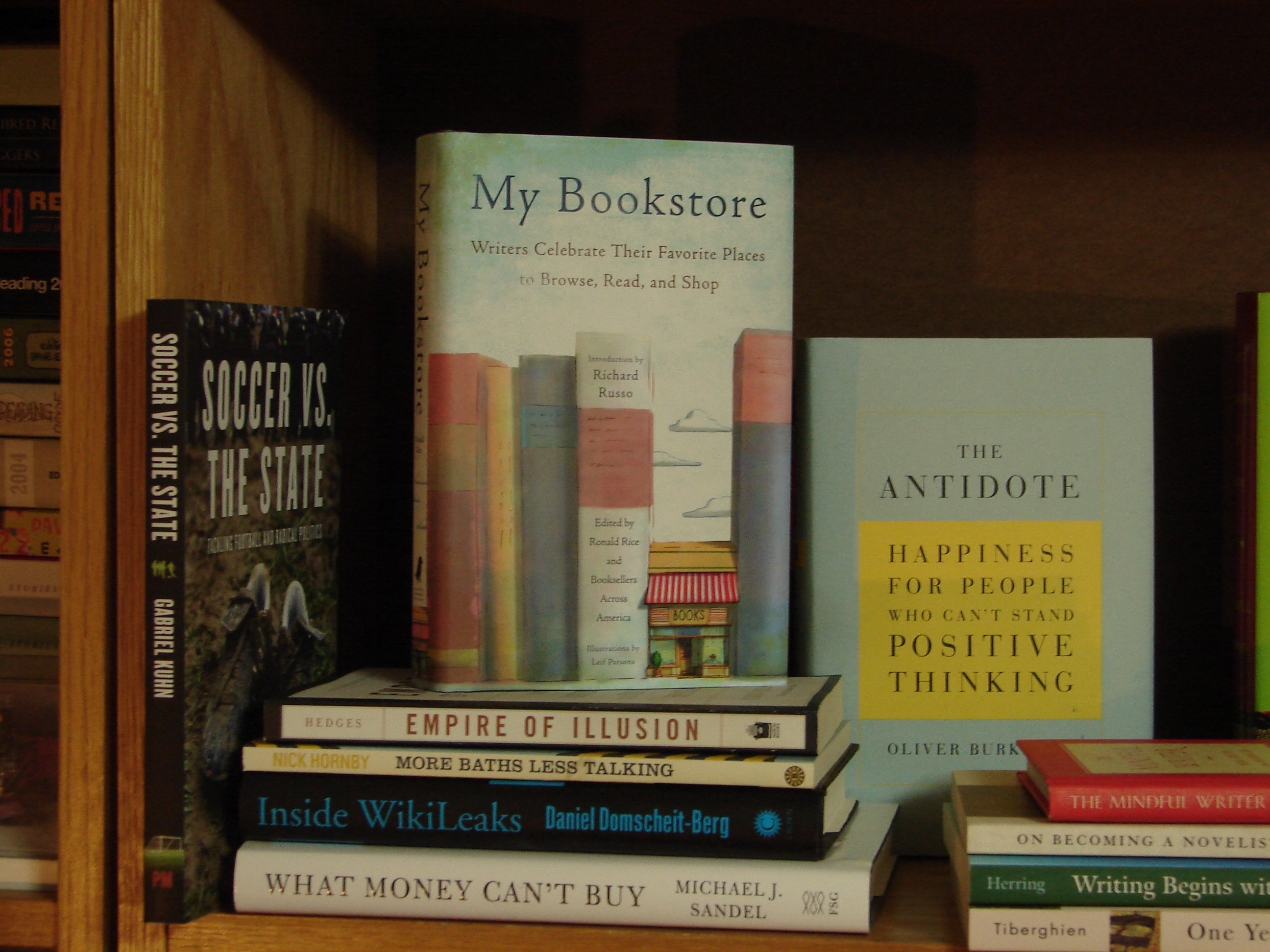
These are the books I’ve read this year…

DSC00907

NonFiction

  • The Antidote:  Happiness for People Who Can’t Stand Positive Thinking by Oliver Burkeman (2012)
  • Empire of Illusion: The End of Literacy and the Triumph of Spectacle by Chris Hedges (2009)
  • My Bookstore: Writers Celebrate Their Favorite Places to Browse, Read and Shop edited by Ronald Rice
  • More Baths Less Talking by Nick Hornby (2012)
  • What Money Can’t Buy: The Moral Limits of Markets by Michael J. Sandel (2102)
  • Soccer vs. The State: Tackling Football and Radical Politics by Gabriel Kuhn (2011)
  • Inside WikiLeaks: My Time with Julian Assange at the World’s Most Dangerous Website by Daniel Domscheit-Berg (2011)
  • Zeitoun by Dave Eggers (2009)

DSC00908

Books on Writing

  • The Mindful Writer: Noble Truths of the Writing Life by Dinty W. Moore (2012)
  • On Becoming a Novelist by John Gardner (1983)
  • Writing Begins with the Breath: Embodying Your Authentic Voice by Laraine Herring (2007)
  • One Year to a Writing Life: Twelve Lessons to Deepen Every Writer’s Art and Craft by Susan M. Tiberghien (2007)

DSC00910

Fiction

  • House of Holes by Nicholson Baker (2011)
  • The Green Shore by Natalie Bakopoulos (2012)
  • Lost Memory of Skin by Russell Banks (2011)
  • A Hologram for the King by Dave Eggers (2012)
  • The Historian by Elizabeth Kostova (2005)
  • The Girl Who Played With Fire by Stieg Larsson (2009)
  • The Girl Who Kicked the Hornet’s Nest by Stieg Larsson (2009)
  • Say Nice Things About Detroit by Scott Lasser (2012)
  • The Odds by Stewart O’Nan (2012)

DSC00907

If you are the kind of person that can lose yourself in the maze of book shelves of a book store; who cherishes the physical structure of the book with its artistic covers surrounding the thickness of pages between; who can smell the wood of the shelves you lean upon as you open one, seeing within not merely black-typed letters on a white page, but rather the gateway to a world of new friends and foes; and that a bookstore is a destination wherein hours are freely and joyfully relinquished and dollars willingly spent, then you are like me, and I would recommend that My Bookstore: Writers Celebrate Their Favorite Places to Browse, Read, and Shop is the book for you.

This tome is a bucket-list of book stores to visit; a collection of business success stories based on love, appreciation and mutual respect between bookseller and readers/writers/communities around the art of the book and the writing within them.  It is about 84 unique independent book stores around the country, demonstrating diversity and resisting a society seeking monocultural consumerism, by the writers who pay tribute to them.

Two stores I have visited and love are recognized.

Politics & Prose in Washington DC has been a must-stop every visit to the nation’s capital, ever since my first visit when Naomi Klein was reading and signing her book, The Shock Doctrine shortly after its release.  At a later visit, I was headed out of town hours before Barbara Ehrenreich was reading and signing her book, Bright-Sided: How the Relentless Promotion of Positive Thinking Has Undermined America.  I paid for the book, and they shipped it to me after she signed it.

The Book Loft of German Village in Columbus, OH I just discovered this year during an extended visit for a Columbus Crew match.  Last year, we added the Columbus Zoo as a planned visit while taking in a match of the closest Major League Soccer team to Detroit, but now the Book Loft is another definite stop while in town.

Through this book, I discovered Nicola’s Books in Ann Arbor, and have since made two visits; the second of which children’s book writer Nancy Shaw was reading and signing her contribution to My Bookstore about Nicola’s Books.  The book also introduced me to two other indy book stores in Michigan – Saturn Booksellers in Gaylord and McLean & Eakin Booksellers in Petosky – that are now on the list of places to find my way to.

I hope that My Bookstore is a success, both in steering readers to the indy bookstores that carry on the tradition of book selling as the heartbeat of the community that no online mega-corp or cookie-cutter franchise can ever replace, and to encourage a second volume which left out two book stores that immediately come to mind – Horizon Books and Brilliant Books in Traverse City – and hopefully many more like them.

526181_10151003546585826_950178219_n

In the fall of 2009, I joined a bowling league.  It was a men’s league in St. Clair Shores, and I was fortunate that an opening was on a team of senior citizens (two over the age of 70, and two over the age of 80).  They were the last place team and participated for the exercise and fun.  They had been in the league for decades.  I hadn’t bowled in a league since around 1982 or 1983, where I carried a 155 average.  This is considered a low average in a men’s league like the one I joined.  Still, I was determined to apply the wisdom I gained over the years to make myself a better bowler, and I set the goal of a 150 average to start.

The league was on Thursday nights, and the bowling alley had a special on Mondays where bowling cost $1.50 per game.  I would practice on Monday, then bowl on Thursday night, in an attempt to improve.  When the 2009-10 season ended, I held the fourth lowest average in the league (144).

I bought a new ball and practiced a couple times a week during the summer and entered the 2010-11 season with the goal of improving my average to a 150.

I played all the mind games – that a 150 average would mean 9 misses or less in three games on the night; that knowing how many frames were left in the game, I would know what my score would be.  I ended the season with a 147 average.  Closer to the 150, and an improvement on the previous season.

In 2011-12, I continued the routine.  I didn’t bowl as often during the summer, but maintained the Monday practice/Thursday league routine.  I applied the same mental games as before, and set that 150 mark as a goal.  There was some frustration that, back in the day, a 150 or better was the norm, and that it was not translating after two seasons and practice almost 30 years later.  My average at the conclusion of this season was again a 147.

For a period in my life I swam in the waters of “positive thinking”; of goal-setting and all that mental focus on living in prosperity.  I read the books and listened to the cassettes, and attended a church that was infused with what Oliver Burkeman in his book, The Antidote:  Happiness for People who can’t stand Positive Thinking (Faber & Faber, Inc. 2012), called the “cult of optimism.”  Since 1991 I drafted and tracked goals on a semi-annual basis.  Some goals were accomplished, others not, and others abandoned because my heart was never into it when I first wrote the goal down. I stopped after 2001 because life was traveling at a dizzying pace.

So I knew the drill, and I set out on this bowling adventure attempting to use this “positive thinking” and “goal-setting” approach, despite feeling the contradiction of this mentality with my Buddhist practice.

Goal setting creates a mindset that you’re not “happy” or “good enough” or “successful” in the present moment.  So you set a goal for a future event that will define you or your work as a success, and thus delay happiness to that point.  To quote Ambrose Bierce’s The Devil’s Dictionary, the future is “(t)hat period of time in which our affairs prosper, our friends are true and our happiness assured.”

In the chapter titled “Goal Crazy: When Trying to Control the Future Doesn’t Work,” Burkeman demonstrates how goal setting backfires with, in some cases, deadly consequences.  “In theology, the term ‘theodicy’ refers to the effort to maintain a belief in a benevolent god, despite the prevalence of evil in the world; the phrase is occasionally used to describe the effort to maintain any belief in the face of contradictory evidence.  Borrowing that language, Chris Kayes termed the syndrome he identified as ‘goalodicy.'” (Burkeman, pg. 78-79).  Furthermore, Burkeman sites a study that shows that those motivated by a goal are more apt to cheat (as well as proves that that the Yale Study of Goals – commonly sited by the positive thinking/goal-setting gurus – does not exist).

Burkeman reasons that goal-setting fails because it doesn’t address the issue we’re really trying to resolve – our uncertainty of the future.  “Faced with anxiety of not knowing what the future holds, we invest ever more fiercely in our preferred vision of that future – not because it will help us achieve it, but because it helps rid us of feelings of uncertainty in the present.” (Burkeman, pg. 86).

After graduating from law school in 2004, and prior to studying for the Bar, I wanted to revisit the goal setting process. However, my deeper practice and study of Zen made the goal-setting process superficial and empty. In re-reading those entries from the twice-a-year logging of goals achieved, shelved, and committed to, I found that there was a lack of satisfaction. There were some things that created great memories. But it felt like an unending checklist that, once some goal was achieved, there had to be something else to replace it. And worse, concepts like being “prosperous” or “intelligent” or “wealthy” or “something better” lacked substance. What is wealthy? When does “wealthy” become achieved? It was like the hungry ghosts of Buddhist teachings, where the ghosts’ mouths are so small, yet their hungry bellies are so large, that no amount of “wealth” or “prosperity” or “intelligence” will be enough to fill them.

I sought to reconcile this and came upon a talk by Sangharakshita called “Nirvana”   In the talk, Sangharakshita discusses “The psychology of goal-setting.” He defines a goal as an objective or “something you strive for.”

“You could, if you like, draw a distinction between striving to be and striving to have. But actually, the two come to the same thing: ‘having’ is a sort of vicarious ‘being.’ A goal is in the end something that you want to be.”

This makes sense to those who have goals of being wealthy, or being intelligent. Then, Sangharakshita takes it to the next step.

“There is one really crucial (if obvious) precondition for setting a goal: it must represent something you aren’t. You don’t want to have or to be what you already are. You can only want to be what you aren’t – which suggests, obviously, that you’re dissatisfied with what you are. If you’re not dissatisfied with what you are, you will never strive to be what you aren’t.”

This dissatisfaction ultimately is a desire to achieve happiness. No one seeks unhappiness. And these concepts of “prosperity” or “intelligence” or “appreciated” or “respected” are never ultimately achieved. Why? Because at any level, there will be felt a need to be more prosperous, or more intelligent or more appreciated or more respected, or for something better. They are the empty bellies of hungry ghosts.

What does Sangharakshita suggest is the fix to this? A change of attitude.

“Rather than trying to escape from ourselves, we need to begin to acknowledge the reality of what we are. We need to understand – and not just intellectually – why we are what we are. If we are suffering, well, we don’t just reach out for a chocolate. We need to recognize the fact that we suffer and look at it more and more deeply. Or – as the case may be – if we’re happy we need to recognize that fully, take it in more and more deeply. Instead of running from it into guilt, or into some sort of excitable intoxication, we need to understand why, what the true nature of that happiness is, where it really comes from. And again, this isn’t just intellectual; it’s something that has to go very deep down indeed.”

It’s now the 2012-13 bowling season.  I did not practice at all during the summer.  I have not practiced on Mondays, but left the bowling to Thursday nights, and Thursday nights only.  I haven’t played the mind games of setting a goal of a 150 average, or calculating in my head what I need to achieve a score in a particular game.  Instead, I’ve shifted my focus to the present frame, the present throw, be it the first one, or, if not a strike, the second one.  With one week left in the first half of the season, my average is a 154.  And the season has been more relaxed and fun than the previous three.

So what are my goals for 2013?  I have none, other than enjoying life, including the uncertainty of it.

Photo by Anna Bruce.

Photo by Anna Bruce.

“A ‘text’ existing only on a screen and in the mind is not, to me, a book. To me, it is not enough that a book is thought realized in language; it must also be language further realized in print on paper pages bound between covers. It is a material artifact, a thing made not only to be seen but also to be held and smelled, containing language that can be touched and underlined with an actual pencil, with margins that can be actually written on. And so a book, a real book, language incarnate, becomes a part of one’s bodily life.”

Wendell Berry – “Carmichael’s Bookstore, Louisville, KY”

“People in a good bookstore use their feet differently; there is never a full step as we are reluctant to drift too fast past the anthologies of fiction, some familiar some new.”

Ron Carlson, “Changing Hands Bookstore, Tempe, Arizona,”

…I start to explain to my toddler that there’s a difference between coffee shops and independent bookstores – and it’s not just that people will happily overpay for a cup of coffee that costs just pennies to make though prefer to pay pennies for a book that costs thousands to produce, but also that, generally speaking, people really need a cup of coffee at 7 a.m., whereas no one really needs a book until mid-morning, earliest, which is why Starbucks is open and Daniel’s (Boswell Book Company) is not.”

Liam Callanan, “Boswell Book Company, Milwaukee, WI”

“But that’s the thing: To Dick, books matter. They are not to be downloaded and deleted. Books are loved and treasured. It is this love, this appreciation of the written word, that suffuses the air of Nantucket Bookworks.”

Elin Hilderbrand, “Nantucket Bookworks, Nantucket, Massachuesetts”

“I’ve visited more bookstores than I can count, and every time I walk into one of them, I get that rush of first love again.”

Ann Hood, “Island Books, Middletown, Rhode Island.”

DSC08935DSC06666

Two of my favorite Indy bookstores;  Brilliant Books and Horizon Books, both in Traverse City, MI

“Put it before them briefly so they will read it; clearly so they will appreciate it; picturesquely so they will remember it; and, above all, accurately so they will be guided by its light.” Joseph Pulitzer.

December 22, 2012