
I have the e-galley now, and very soon, Grey Wolfe Publishing will begin accepting pre-orders. Stay tuned!
I also have two short stories published in Legends: Summer 2013 which can be pre-ordered here.

I have the e-galley now, and very soon, Grey Wolfe Publishing will begin accepting pre-orders. Stay tuned!
I also have two short stories published in Legends: Summer 2013 which can be pre-ordered here.

It’s not often that a sporting event causes me to get choked up. I’ve had a few special sports moments in my life. But July 17, 2013 surpassed them all. It wasn’t a championship game. It didn’t feature a legendary player or create a moment in sports history. It wasn’t even a game that mattered in the standings.
But it mattered to me.
I was at Harry’s Bar. I don’t drink, and bars are not where you will usually find me. But Harry’s Bar in Detroit is just a couple blocks away from Cass Technical High School. No, I wasn’t waiting for kids to get out of school. It’s July, and my kids are well beyond the high school age.
I was at Harry’s Bar because I was joining the supporters groups – The Northern Guard Supporters , The Motor City Supporters, and Le Rouge Supporters. It’s the pre-game tradition since the team’s first match last year, for Detroit City FC fans.
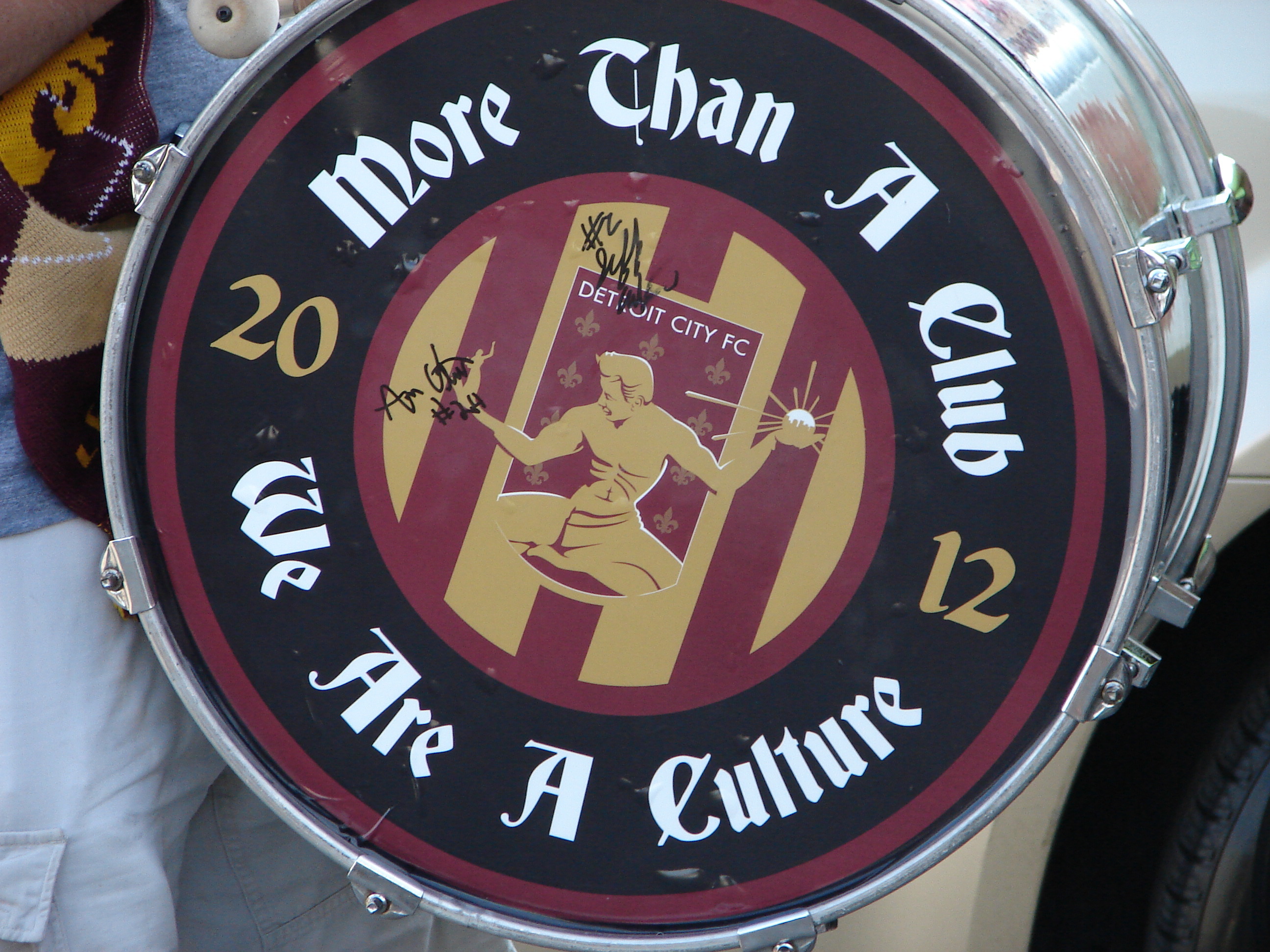
Detroit City FC is a soccer team. They play in the National Premiere Soccer League, and just wrapped up its second season. The team went undefeated during the regular season – eleven wins and one draw – beat AFC Cleveland 3-1 in the semi-finals, but was eliminated from the playoffs over the weekend by the Erie Admirals on our home pitch at Cass Tech Stadium.
Wednesday, July 17, 2013 was the final match of the season. A friendly[i] against the Windsor Stars from the Canadian Soccer League. The general mood was upbeat, subdued from the vibrant energy that filled Harry’s prior to the playoff matches over the weekend.
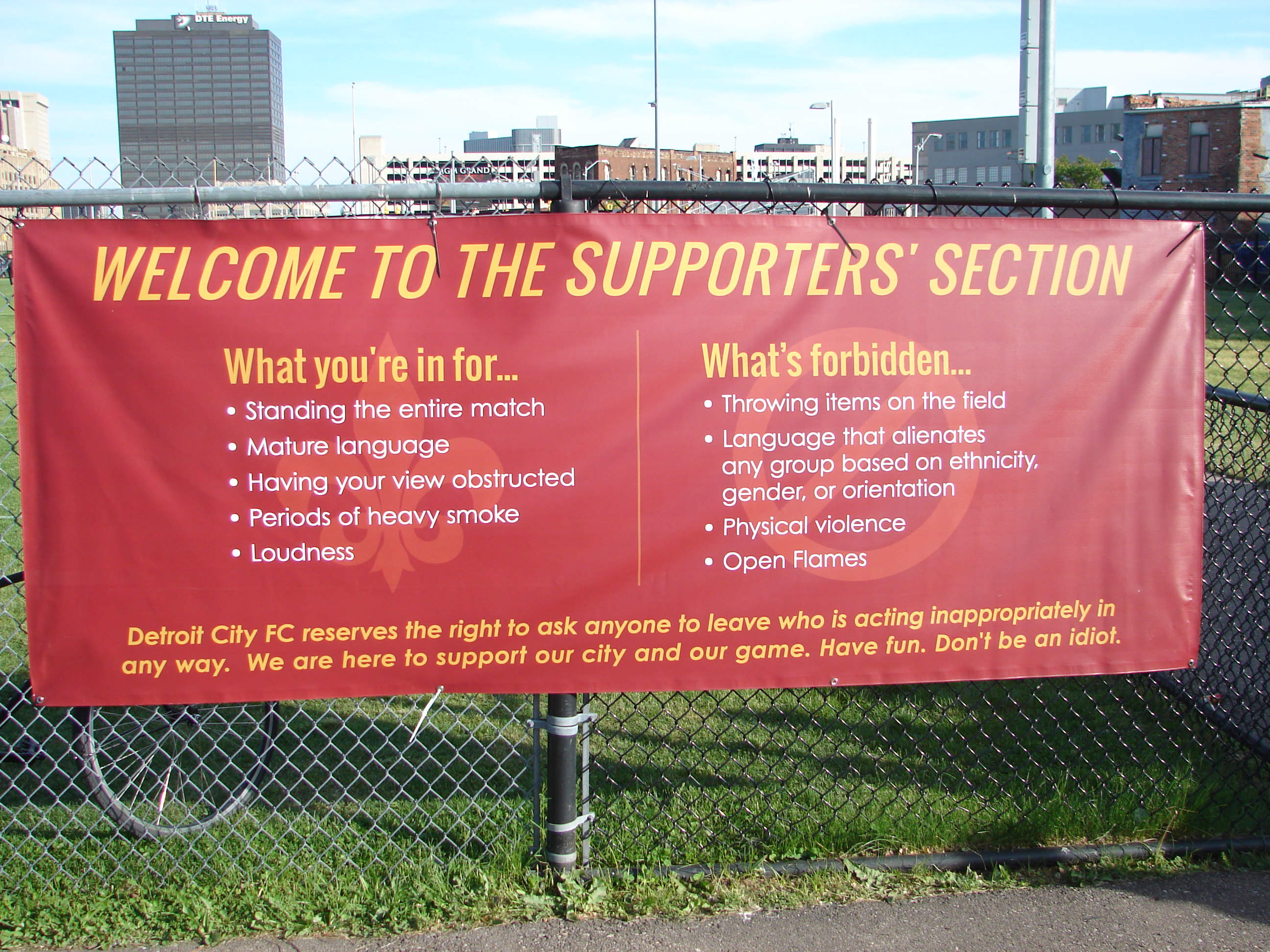
The Supporters meet in the parking lot prior to the DCFC matches, to walk over to the stadium together. That’s an understatement. The Supporters meet in the parking lot, with drums, flags, and smoke sticks, and are led by Sergeant Scary – a charismatic young man with clever creativity – to march as a group to the stadium, singing and chanting, through the neighborhood.
 I must pause a moment here to clarify. I haven’t considered myself qualified to call myself a supporter. Yes, I’ve been to every DCFC match over the two years. Yes, my bank account has seen many hits from the DCFC souvenir stand and my wardrobe has become very rouge and gold.

Yes, I have photographed every match, including the torrential downpour we experienced playing FC Sparta Michigan at Cass Tech, which threatened the functioning of my six year old digital camera.
 Yes, I consider myself City Til I Die. But the first season I stuck to the “family-friendly” side of the stadium in order to photograph and video not only the players but the Supporters that filled the west side bleachers with their singing, chanting and smoke sticks. They were as much the entertainment as the beautiful game being played on the pitch. It wasn’t until last year, the last game (also a friendly against Windsor) that I did the routine of Harry’s Bar, march to the stadium, and hang out on the Supporters’ side of the field.
This evening, we gathered in the parking lot, as normal. Sgt. Scary had an announcement. After the loss on Sunday, the Erie players ran over to taunt the Supporters section (instead of celebrating with their team and the handful of fans that made the trip to Detroit). It caused a handful of boneheads from the section to toss empty plastic water bottles at them. As a result, Erie complained to the NPSL, who contacted Detroit Public Schools (DPS). The Supporters were told that DPS officials would be at the game, to observe the Supporters behavior. Therefore, the Supporters were going to show DPS and the league what they would miss by not having the Supporters there.
We began with a silent march to the stadium. No chanting. No drumming. No smoke. The residents of the neighborhood were confused. They asked us why we weren’t singing. They wanted, and almost demanded the group to perform, as it had become something they looked forward to every DCFC match day.
We entered the parking area between the school and stadium, where the usual chant would be made:
Can you hear (visiting team name) sing?
No No
Can you hear (visiting team name) sing?
No No
Can you hear (visiting team name) sing?
We don’t hear a fucking thing!
No No No
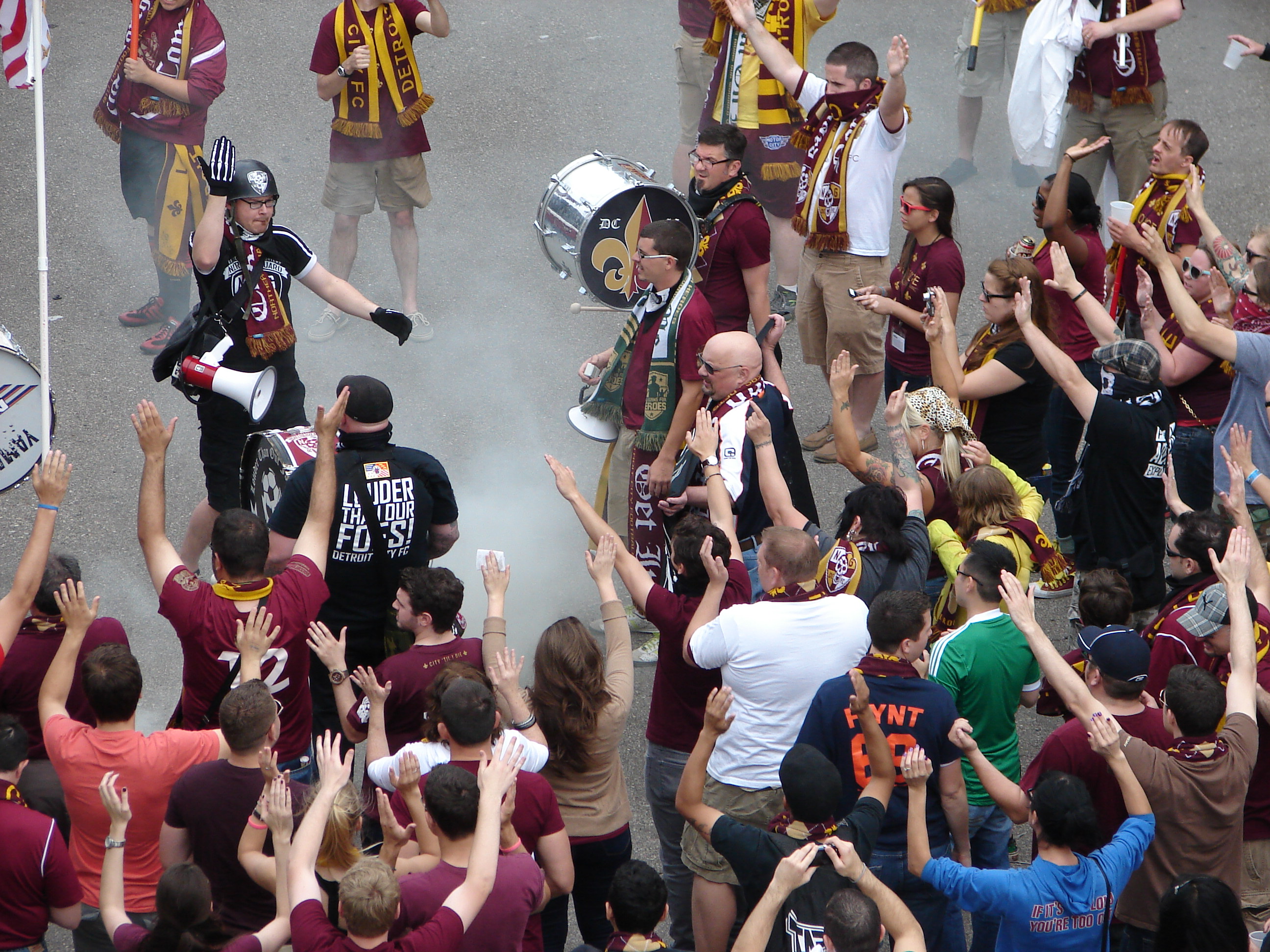 This evening we stood in silence.
Then we entered the stadium, where things became humorous and surreal. The Supporters filled the west stands. The chants and songs were altered. As the teams waited in the tunnel on the opposite side of the field, the first chant to emerge was The Barney Song. Then, instead of chanting “Come and Get It” as a taunt to the visiting team as they walked onto the field, we chanted “Thanks for Coming.” It only got sillier from there.
When the ball came in to the Supporters section, the norm is to toss it back out on the field. But this night, the ball would be tossed followed by a chorus of apologies (after all, we’re not supposed to throw anything on the field).
There was even a chant of “You’re the Greatest Ref, We’ve Ever Seen”
Then, at the 20 minute mark of the first half, the always standing, always chanting Supporters, in unison, sat in silence. For ten minutes. It was eerie. You could hear the players shouting to each other.

At the end of the first half, the Supporters wanted to continue to make the statement of what a DCFC match would look like without them. We picked up and moved to fill a section on the “family-friendly” east side, leaving the Supporters’ Section near empty.
When the second half begun, the usual nursery rhymes and generic sports chants continued. At the 70th minute, DCFC captain Josh Rogers, spoke with the leaders of the Supporters, telling them to “get the fuck back to your side of the field” and make some noise. They (the players) wanted the cheering and wanted to thank the Supporters for their support during the season at the conclusion of the game. Sgt. Scary was going to wait until the 80th minute to march back, however a young woman’s voice from the section shouted, “Back to normal!” and the Supporters created a mass exodus from the family friendly side, chanting and singing all the way back to the west bleachers.
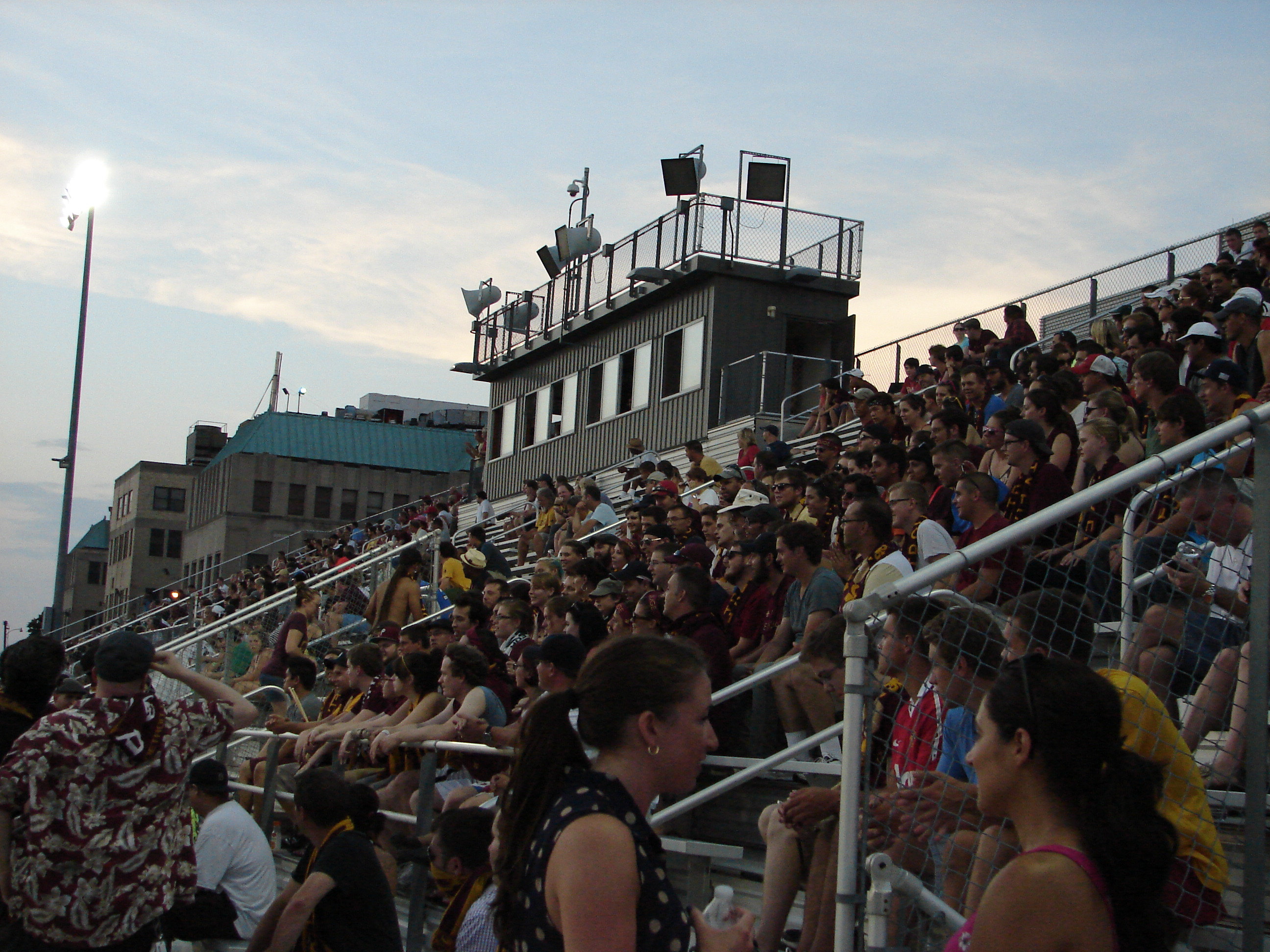
It was an explosion of pent-up, enthusiastic and authentic support for this team in rouge and gold that we love that commenced. The chants and songs seemed louder. Smoke filled the stands and field. All was right with the world once more.


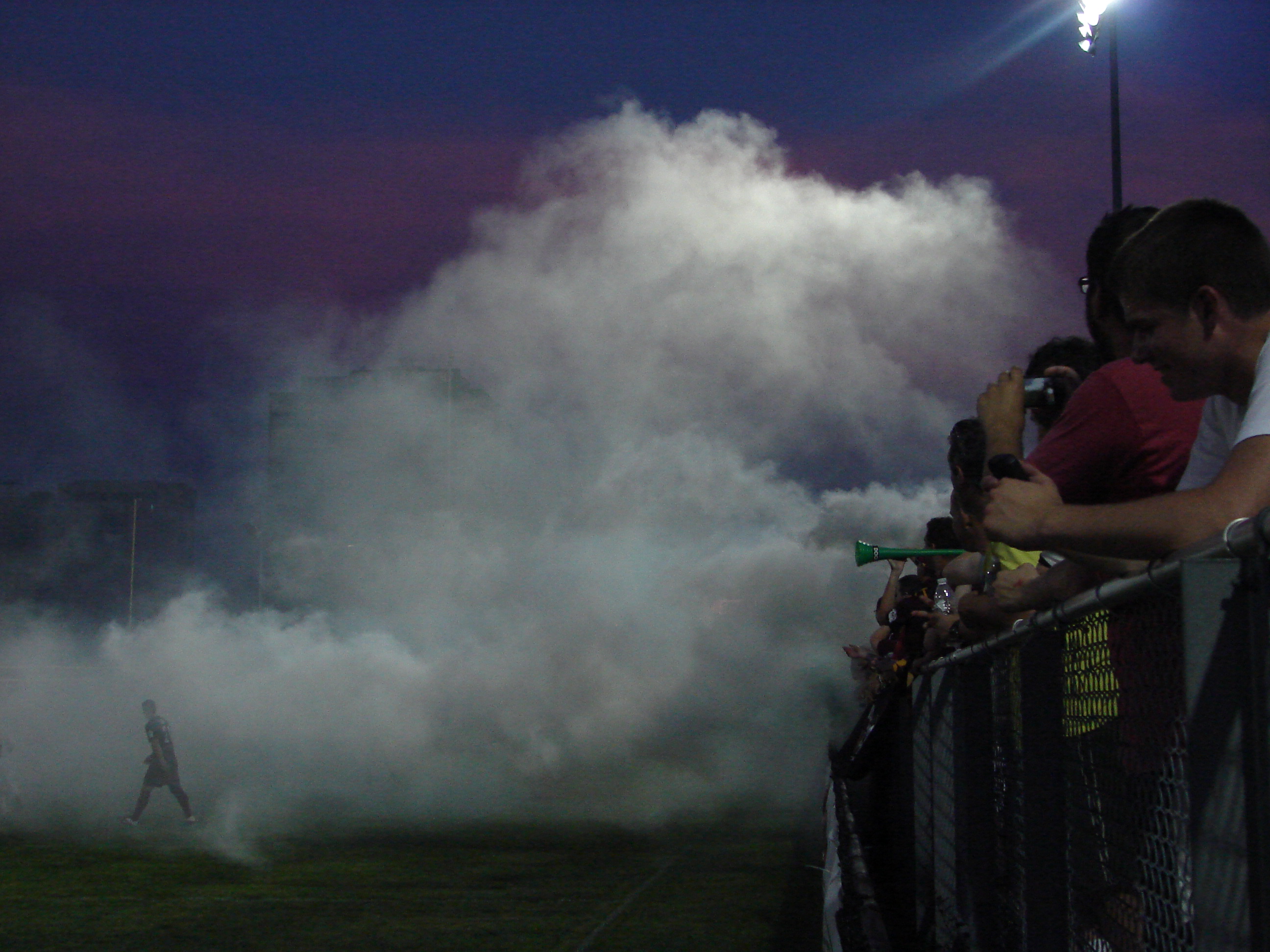 Not being blessed with the gift of athleticism, I’ve been a sports fan for decades. Mostly hockey and especially the Detroit Vipers of the International Hockey League. I still wear my Vipers jackets/sweatshirts to this day, my blood running the color of aqua and eggplant. But the Detroit Vipers dissolved in 2001 and my first trip to Columbus in 2002 to a Columbus Crew match revived my interest in soccer (I was a Detroit Express fan back in the North American Soccer League day). I photographed for a hockey publication at the Detroit Vipers games, which took me on the ice and in the locker room when they won the 1997 Turner Cup. I’ve been involved in booster clubs, presiding over the Detroit Jr. Red Wings of the Ontario Hockey League for two seasons. I was even a member of the Detroit Red Wings For’em Club for a season. I’ve marched in anti-war and other protests. But none of that prepared me for what happened this night.
I’ve seen this on television – watching English Premiere League matches and Portland Timbers home games. I’ve witnessed it at Crew Stadium (in the Nordecke) and the first season of DCFC. Tonight it became real. Tangible. Consuming. I was not a spectator. I was not a fan. I became part of something more. A culture. A community where there is a mutual appreciation between the club and the supporters. Something I’ve not experienced with any team or sport – not even my beloved Vipers.
The transfusion is complete. The aqua and eggplant blood is gone. It runs rouge and gold now. This is my tribe. I am a Northern Guard Supporter.
[i] A “friendly” is an exhibition match.
On July 10, 2013, I signed a book contract with Grey Wolfe Publishing for my novel, The Y in Life.
This past Wednesday, I received the first round of edits, and having gone 200 pages of the 375 in the manuscript, the rewrites have been marginal.
As of this moment, I have two stories being published in Grey Wolfe Publishing’s quarterly Legends, which is due out in August, and my novel The Y in Life slated for a Fall release (Sept/Oct).

Photograph by Michael Kitchen
Grey Wolfe Publishing’s “Legends” is set to come out soon. This quarterly will be publishing my two stories, “Mother Nature Makes the Extra Point” and “The Word of the Day is ‘Trust'”
Grey Wolfe Publishing is taking pre-orders, so if you’d like to save $5, order today at Grey Wolfe Publishing.
You’re going to want to pick up Grey Wolfe Publishing’s Summer edition of Legends. Not only has my new short story, “Mother Nature Makes the Extra Point” been accepted for publication, so, too, has my award-winning short story, “The Word of the Day is ‘Trust.'”
For more info about Legends, go to Grey Wolfe Publishing’s website and/or Facebook page.

I have just received an email from Grey Wolfe Publishing:
Dear Mike,
We are pleased to inform you that your story, “Mother Nature Makes The Extra Point” has been selected for inclusion in the Grey Wolfe Publishing summer edition of our quarterly literary journal, “Legends”.
According to the email, the “Summer Legends will be released and available for purchase on Amazon and for the Kindle by August 31, 2013. Please watch our website and Facebook page for the official release announcement.”
Stay tuned!
I was browsing a local book store recently and a title on the New Arrivals table caught my eye. It was one of the local history books published by Arcadia Publishing, titled Legendary Locals of Detroit by Paul Vachon. The cover is adorned with fifteen black & white portrait photographs of some of the locals revealed within. I settled down in the cafe area with a brownie and pop, and flipped through the book. By the time I reached the end, I was once again disappointed.
This is a rant. I’m not singling out this book, it just seems to have pushed me over the tipping point.
Let me preface by saying that I am biased in my opinion on this. I co-wrote Down Through the Years: The Memoirs of Detroit City Council President Emeritus Erma Henderson with her. And when I began working on the project in 1999, up through today, I can’t find the words to express my feelings about the lack of inclusion of Erma Henderson in books covering recent history of Detroit. When I saw Legendary Locals of Detroit, I was certain I’d find Erma mentioned within.
Chapter One is titled “Firsts” which covers pioneers who “were unsung heroes who advanced the causes of civil rights, often at risk to their own safety.” Included in this chapter is Mary Beck – the first woman elected to Detroit’s Common Council (City Council) – and Jennifer Granholm – Michigan’s first woman governor who was born in Canada, and has no connection to Detroit.
Not Erma.
Chapter Two is titled “In The Public Square.” Included in this chapter are Detroit City Council members Maryann Mahaffey and Mel Ravitz, along with mayors, judges, governors and other social justice leaders.
Not Erma.
The rest of the book depicts people in the fields of business, sports and art, with a final chapter on “Demagogues. Disrupters, and Dissidents” which includes gangsters and racists.
How is it that Erma Henderson is always overlooked in Detroit history books?
Erma Henderson was not the first woman on City Council, but she was the first African American – male or female – to be elected President of the Detroit City Council, by accumulating the most votes on election day. And she held the presidency for four straight terms! The election she won in 1972 to get on the Detroit City Council was in a head-to-head contest against Jack Kelly, an influential and popular white male. Kelly was elected to City Council the following year, 1973, along with Erma, when the entire council was up for election.
On Council, Erma took on the insurance and mortgage companies and banks, leading an anti-red lining campaign that challenged Michigan’s laws that allowed the practice of denying insurance and loans or charging exorbitant rates, to credit-worthy individuals and businesses simply because they were located in a particular area red-lined by financial institutions. Her crusade caused the Michigan legislature to enact the most comprehensive Anti-Redlining laws in the nation at that time. A woman thirty years ahead of the Occupy movement.
She fought for civil rights as early as her high school days, where she demanded that the high school senior class photo no longer place all the black graduates at the bottom of the photo – where they could be clipped off. The school changed the senior class photo and placed the students in alphabetical order. In 1938 she led a sit-in at the Pantland Hotel in downtown Grand Rapids where she was attending the Michigan Republican Convention as a delegate, but was denied a room at the hotel because the hotel refused to allow minorities accommodations.
She was named the Executive Director of the Equal Justice Council following the 1967 disturbance where she coordinated the monitoring of the courts and compiled data on judges, attorneys and defendants. The court watchers documented evidence of indifference towards poor and minority defendants. The data was analyzed and published by the University of Michigan School of Social Work, which was a major factor in (1) the elimination of some visiting judges, (2) permanent funding for full-time jail ministry, (3) and several new judgeship appointments to Detroit’s criminal courts. It was nationally recognized as being the most effective court-watch program in the nation in 1974.
She founded the Women’s Conference of Concerns which became a major coalition-building base of power for women’s organizations in Southeast Michigan.
Among the gallery of awards that she was honored with includes:
She has both a school and a park named in honor of her – both during her lifetime. Detroit City Council meets in the Erma Henderson Auditorium.
And I’m just scratching the surface.
Yet, Erma Henderson is not a legendary local. Why not?
Her entire life was dedicated being a champion for the people of Detroit.
Detroit history writers – quit overlooking Erma Henderson.

Erma Henderson & I at her book signing at Borders in Detroit. Photo by Denise Kitchen
I was thumbing through an old journal when I came across this interesting entry.
While I still was running Waking Up in December, 2006, a friend of mine suggested that I seek out paid writing work. I had an abundance of time in the store when no customers were around. I mentioned that I had begun working on a project. He asked if it was a paying project and I said no, that it was the novel I’ve always wanted to write. He quoted someone as saying that every person has a great novel within them, but in most cases, it should stay within them.
I’m glad I didn’t take that advice.
And you shouldn’t take it, either.
Being compensated financially for one’s writing is something that is merited. If a writer puts in the effort, she should be compensated by her readers who partake in the enjoyment of her work. However, to me, that is secondary. Writing to get paid is capitalist rhetoric. Getting paid for one’s writing is freedom.
For the disadvantages and dangers of the author’s calling are offset by an advantage so great as to make all its difficulties, disappointments, and maybe hardships, unimportant. It gives him spiritual freedom. To him life is a tragedy and by his gift of creation he enjoys the catharsis, the purging of pity and terror, which Aristotle tells us it the object of art. For his sins and his follies, the unhappiness that befalls him, his unrequited love, his physical defects, illness, privation, his hopes abandoned, his griefs, humiliations, everything is transformed by his power into material, and by writing it he can overcome it. Everything is grist to his mill, from the glimpse of a face in the street to a war that convulses the civilized world, from the scent of a rose to the death of a friend. Nothing befalls him that he cannot transmute into a stanza, a song, or a story, and having done this be rid of it. The artist is the only free man.
W. Somerset Maugham The Summing Up
Photograph by Michael Kitchen
I met my hero, William Kent Krueger, on Monday. Maybe hero isn’t the right word. His work hasn’t influenced me, mainly because I haven’t read his writing. But he’s lived the writing dream that I seek.

William Kent Krueger at Metro Detroit Book and Author Society luncheon, 5-20-2013. Photo by Michael Kitchen.
Krueger has published 14 novels, many of which feature Cork O’Connor, his mystery series character. His current novel, Ordinary Grace (Atria Books, 2013) made the Indie Next List in April, 2013. And he was a speaker at the Metro Detroit Book and Author Society luncheon on Monday, May 20, 2013.

William Kent Krueger at Metro Detroit Book and Author Society luncheon, 5-20-2013. Photo by Michael Kitchen.
He is living my writing dream.
After the event, I purchased Ordinary Grace and approached him with the question of how he started – by submitting to agents or publishers first? He explained he went through an agent and was able to get his first book sold. He also talked about how self-publishing “back in the day” (he’s about the same age, maybe a handful of years older than I) was taboo, however that has changed immensely. I mentioned that self-published books didn’t get into the book stores, and he said that things are opening up, that as the author, I have more control, and that self-publishing is something to consider.
Huh.
I’ve been attending a number of author events – writer’s conferences, book signings, luncheons, National Writers Series lectures – to bring me up-to-date on how today’s authors are making it in to traditional publishing. I’ve learned that there seems to be two ways.
1. Many of the writers have either a) pursued a Masters in Fine Arts, and by doing so have made connections through the programs they’re in, or b) have made similar connections by working in the field of media entertainment.
Or
2. As Brad Thor, who also spoke at the Metro Detroit Book & Author Society luncheon, did. He and his wife were spending their honeymoon in Europe and shared a train car with a brother and sister from Atlanta, Georgia. The woman happened to be a sales rep with Simon & Shuster, and he submitted his first manuscript to her. He has since published twelve novels at Simon & Shuster.

Brad Thor at Metro Detroit Book and Author Society luncheon, 5-20-2013. Photo by Michael Kitchen.
These are not the circles I travel in. I’m still paying off law school student loan debt, so pursuing another degree is not in consideration. But like in my law practice, I am continuing my writing education by taking seminars, engaging in writer’s groups and studying the craft. And unless an employee of a major publisher is appointed to me by the Macomb County Circuit Court, it is unlikely I’ll ever fall into a situation where a Brad Thorish personal connection could ever take place.
How long will I continue pursuing that which seems as likely as hitting the lotto? It’s time to give self-publishing serious consideration.
I have experience at it, through writing and publishing Erma Henderson’s memoirs. And better, I know a publisher whose business platform is not just to take your money and publish your manuscript (no matter what the quality) and send you on your way. This publisher will not accept a manuscript that is poorly written, and provides copy editing as a part of its service. It is also focused on getting its books on the shelves of book stores, not just the ability to order the book. And the editor has a sincere passion for encouraging and helping writers hone their craft and for book publishing.
I was concerned about publicity, as the commercial publications tend not to review self-published books, and tend not to include them on best-seller lists. The Indie-Next List that promotes books in independent book stores, covers only books that are traditionally published. But, I’ve discovered that Shelf Awareness – a source of news for book sellers – includes a best sellers list of self-published books (provided by IndieReader). The chance to be reviewed in a magazine available in the chain book stores – ForeWords Reviews – also exists (which is published Traverse City – my home away from home). And I’m probably just scratching the surface of the world of independent and self-publishing.
And, I have William Kent Krueger, living my dream, encouraging a new author like me to seriously consider self-publishing. Why? Maybe my dream has a dark side?
There are still a number of agent queries out there for The Y in Life. I’ll give them the opportunity to respond. But after the date I have in mind, the novel goes the self-published route and will likely be available before the end of the year. And the NaNoWriMo novel I wrote in November which is in rough form, I have begun rewriting for definite publication through my independent publisher.
Seriously, when have I ever been “traditional?”
Thursday is bowling night for me. Last night, I arrived early as I normally do. The television screens hanging between the computer screens showing our bowlers and scores were tuned in to the Detroit Tigers baseball game. It was a rebroadcast of the game played earlier in the day, where the Tigers hosted the Blue Jays and won 11-1. Taking glancing views of it something caught my eye.
Where were all the people?
The lower level stands were sparsely populated, and though the box score indicated almost 29,000 in attendance, that seemed highly unlikely. 2,900 would have been a more believable number to the naked eye.
But then I remembered that a week ago, 45,051 packed the Tigers’ home stadium for Opening Day.
I acknowledge that I am a sports fan. I’ll block out time to go to a Detroit City FC match or drive to Columbus, Ohio for an MLS Columbus Crew game. I belonged to team booster clubs, and felt that places like The Palace in Auburn Hills, Crew Stadium, Highbury and the Montreal Forum were holy grounds.
But Opening Day in Detroit reminds me that the best part of sports is the fans…and the worst part of sports is the fans.
The best of sports fandom for Tigers’ Opening Day were the 45,000 fans that purchased tickets and viewed the game rooting on their team as well as the fans who watched the game from their homes, from local taverns or even from bars in Detroit. They have a passion and care for the game and the results, and the team. The Tiger’s home stadium is a hallowed ground to them.
The worst part of sports fandom for Tigers’ Opening Day were those “fans” that use it as an excuse to party and trash the City of Detroit. Littered streets, jaywalking drunks, and use of the sidewalks and building walls as public urinals leaves the City and its residents to clean up this boozy landfill. They even destroy historic homes.
When I brought this issue up on my Facebook page, an ex-friend (he “unfriended” me at the conclusion of our conversation), argued that the problems were the result of a minority of people, that it happens everywhere like U of M and Detroit Lions games, and that yes, people should be more discrete in their urinating. I wanted clarity as to what he meant by being more discrete. The use of public rest rooms, right? No. This white suburban law enforcement officer said that most of the parties do not have adequate restroom options and that people should “relieve themselves” discretely.
In other words, public urination by those who go to Detroit to party during Opening Day – not even taking in the game, but going from party to party and getting drunk – was appropriate if done discretely. I didn’t get a chance to ask him if a homeless person – on a day other than Opening Day – could also be allowed to discretely urinate in public, or would this law enforcement officer arrest the homeless person on a criminal charge that would put him or her on the sex offender registry. Nor did I inquire whether he was experienced and could explain exactly how to discretely urinate in public. I was too shocked and disgusted by his sense of privilege and entitlement and he had unfriended me by then.
I mention “privilege” because the unfortunate fact is the demographics of our area is deeply segregated. Using US Census Data, the residents of the City of Detroit are 82.7% African American. Detroit is within Wayne County, and the White residential population within Wayne County, not including Detroit, is roughly 87.3%; Macomb County is 85.2% White, and Oakland County is 77.7% White.
Phreddy Wischusen wrote an op-ed that was published the day before Opening Day in the Michigan Chronicle, detailing experiences he’s had on previous Opening Days.
Wischusen is not some radical African American Detroit resident. He is a middle class white man whose trust fund paid for his college. He details exposure to racism by white people who express their racist thoughts with him because they feel he, being white, is in agreement with them. I can relate, as I have had that experience all too often myself – not specifically on Opening Day because I am not a baseball fan – but in other settings.
Again, I’m a sports fan. I understand celebrating the opening of your favorite sports team’s season. I love enthusiastic sports fans, like the Northern Guard Supporters and Motor City Supporters at Detroit City FC matches. I admire the creative and absurd like Crazy Claude – the trumpeter – and those strange guys dressing up in full body spandex suits. And sitting amongst the Timbers Army in Portland is on my bucket list.
I absolutely do not get the people who go to a city where an event is happening solely as an excuse to party. These people are not Tigers fans or sports fans. And in the case of Detroit and Opening Day, they are a part of the problem.
I’ve never been a drinker, so I don’t understand the need to drink so much alcohol on Opening Day in Detroit you use Facebook as a means to find a ride home because you’re too drunk to drive; to cause destruction; and/or to “discretely” urinate in public, under the excuse of it being “Opening Day.”
Opening Day is for baseball and the fans who watch it and follow it. Like the few real fans who showed up and watched the non-Opening Day game against the Blue Jays.

Photo by Michael Kitchen
 DoHaeng Michael Kitchen