
April 25, 2015
Friendly
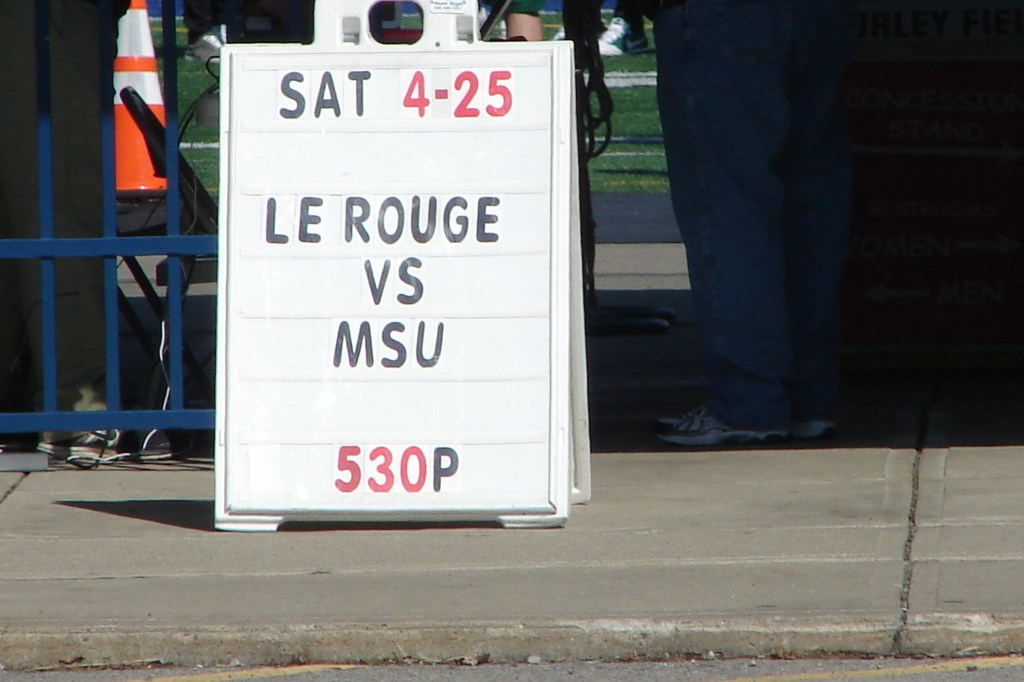
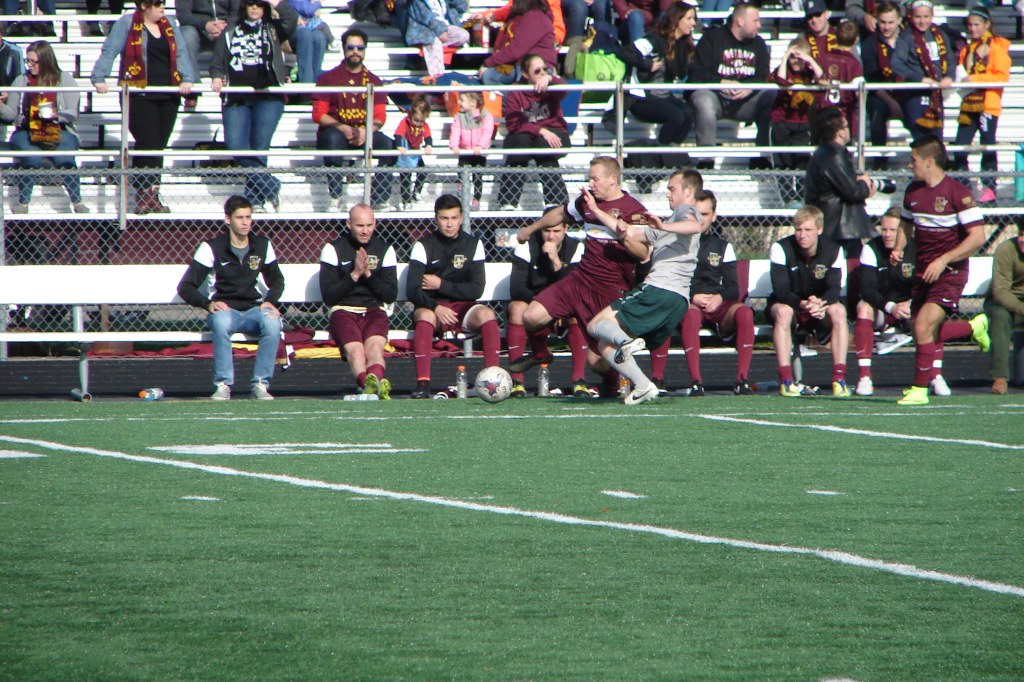
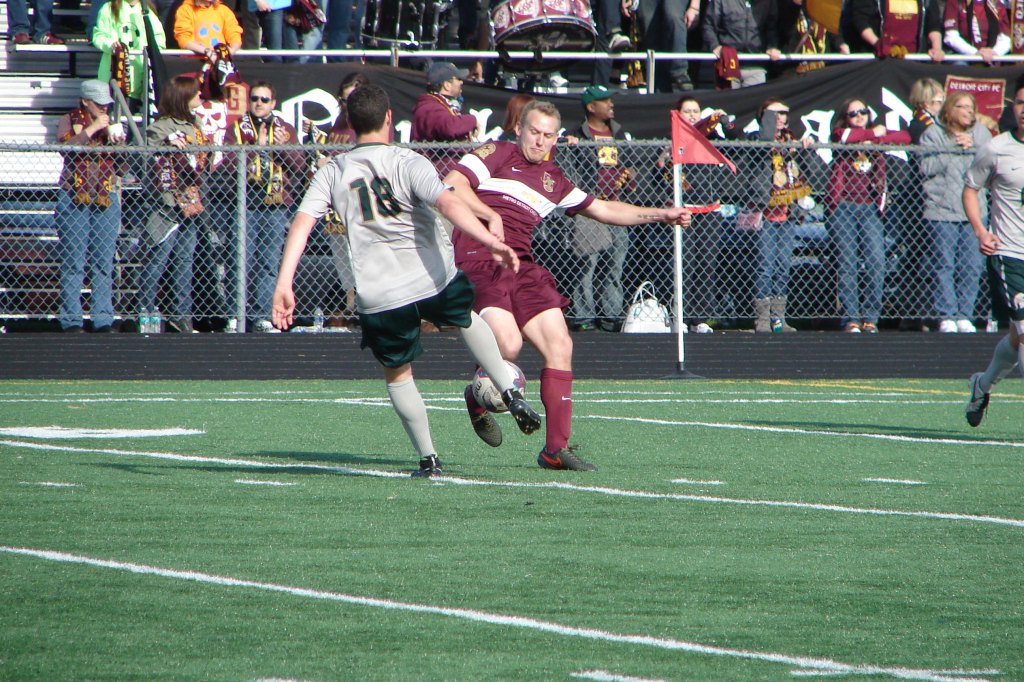
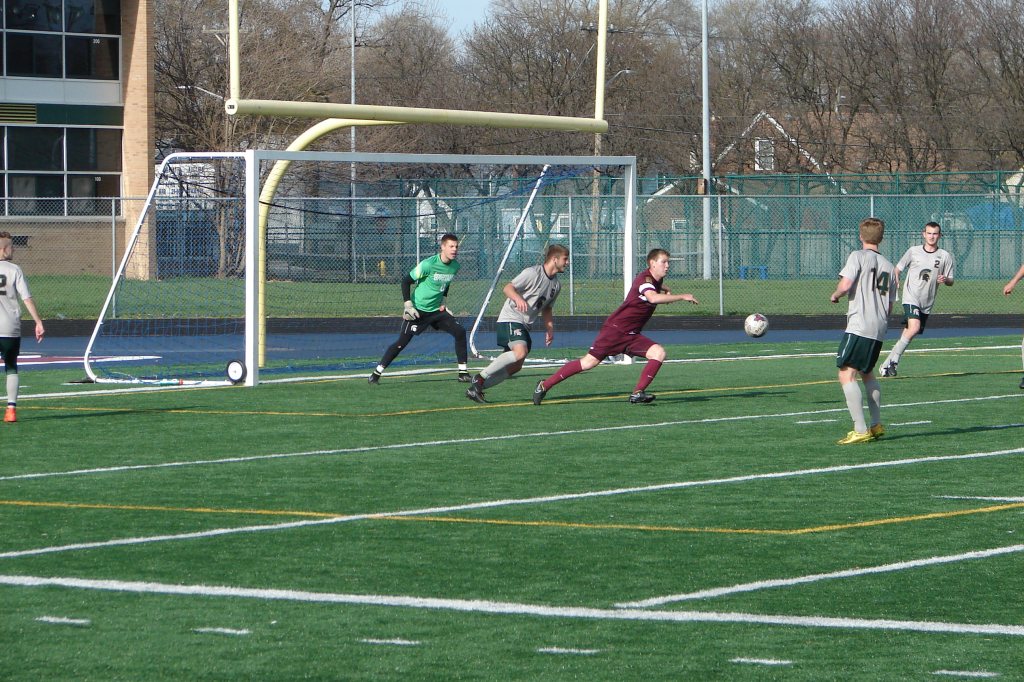
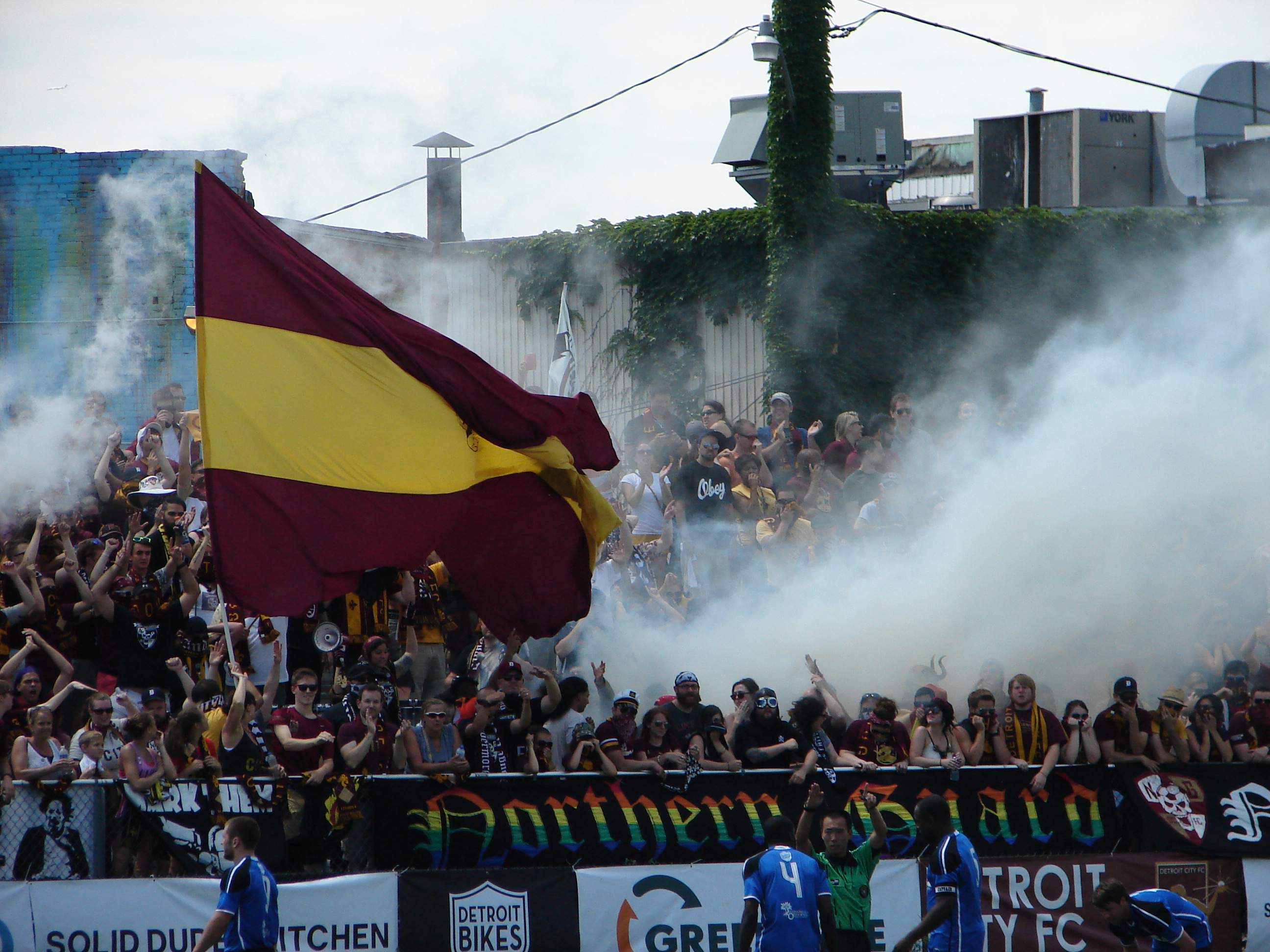
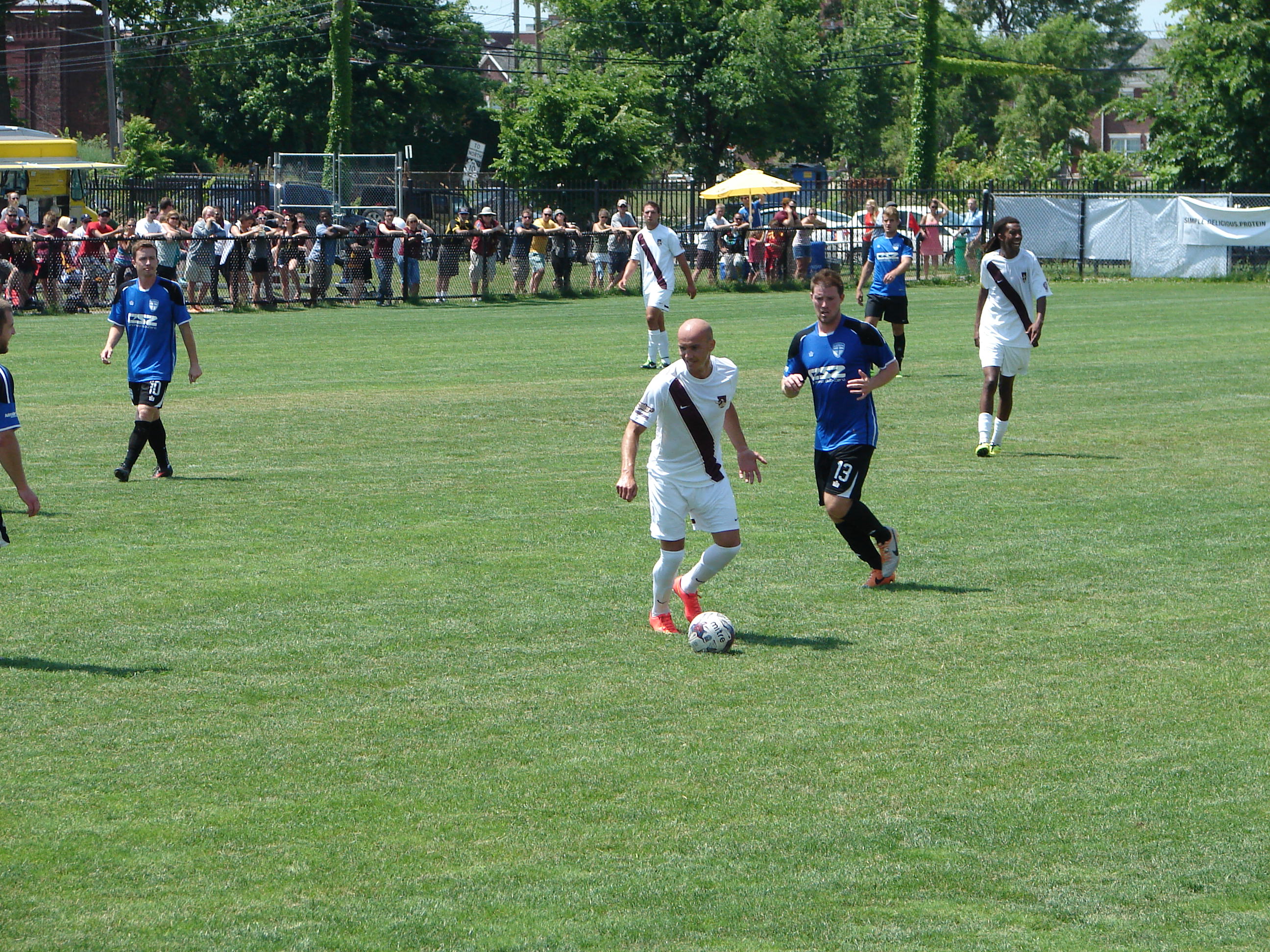
Detroit City FC 0, Michigan State Spartans 1
Hurley Field, Berkley, MI
Attendance: 1,108
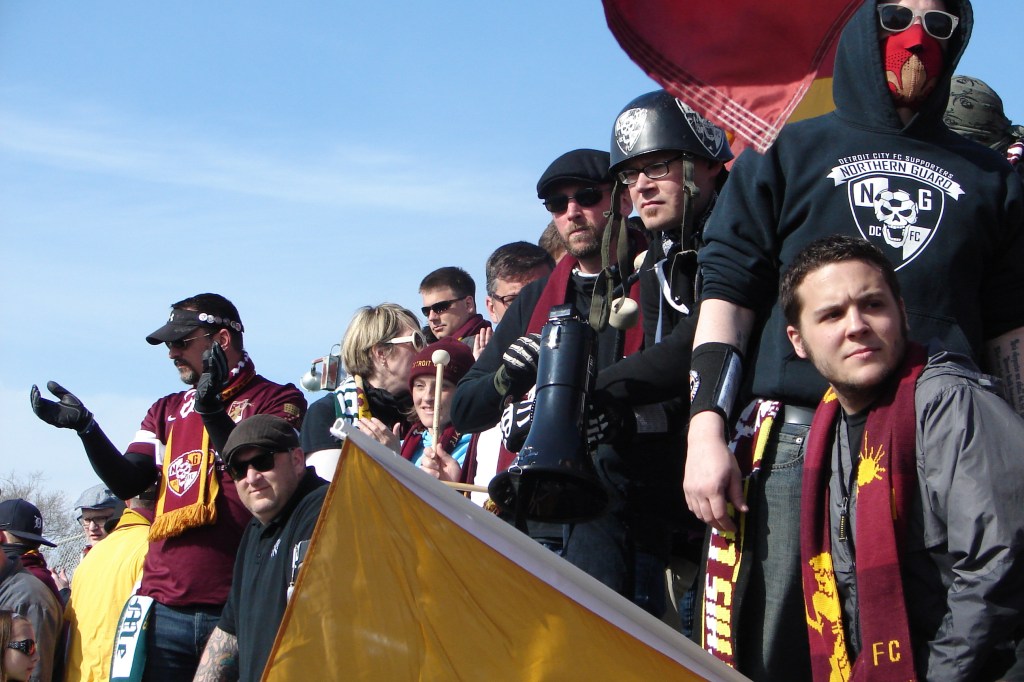
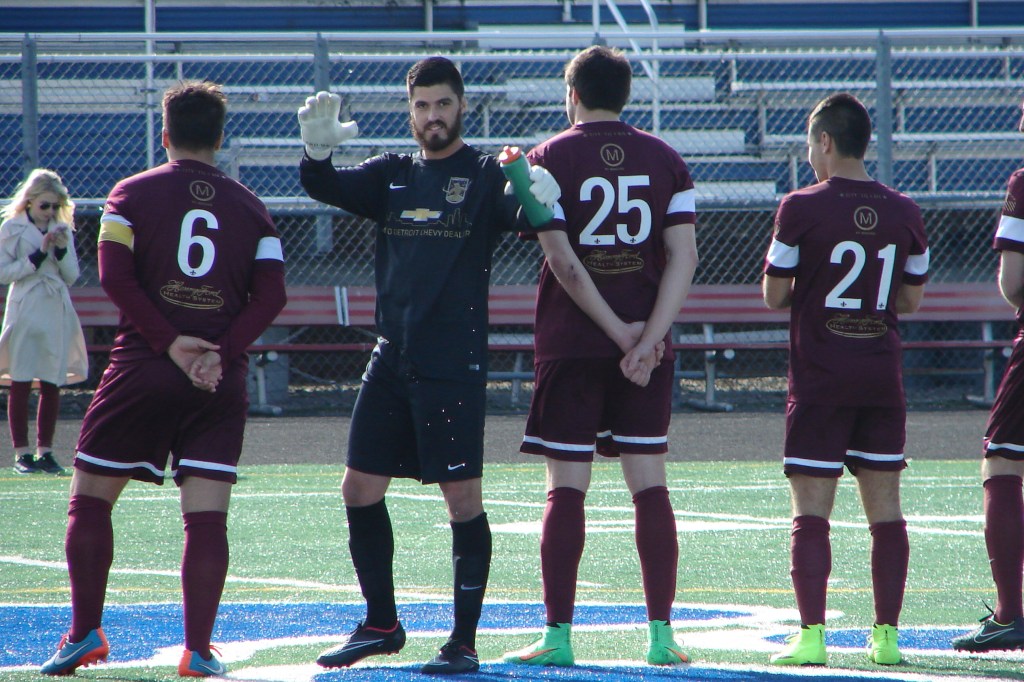
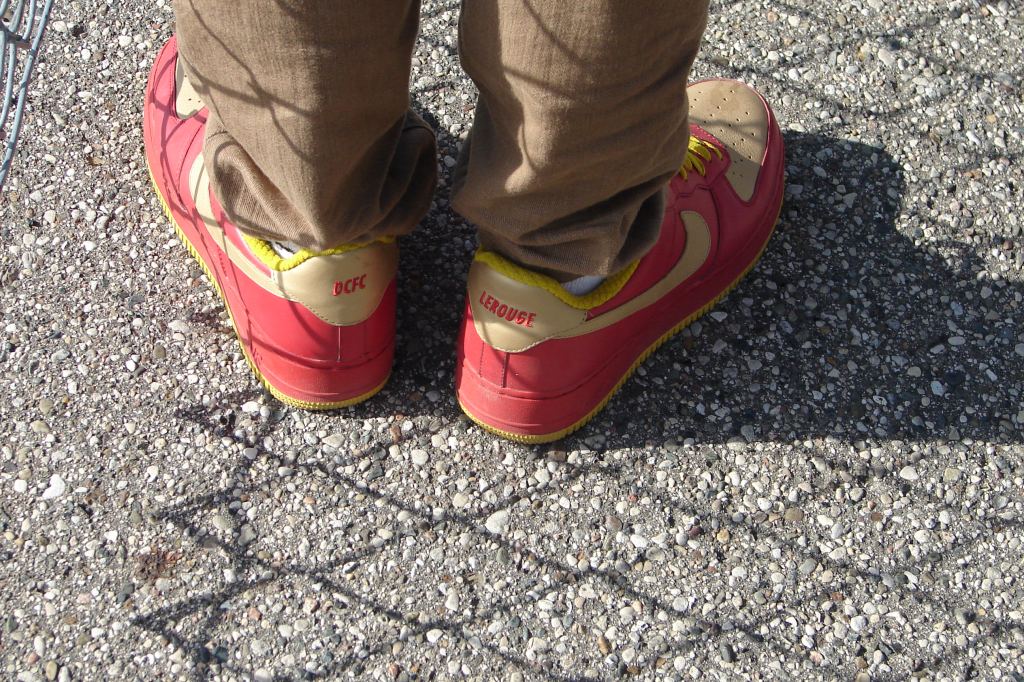
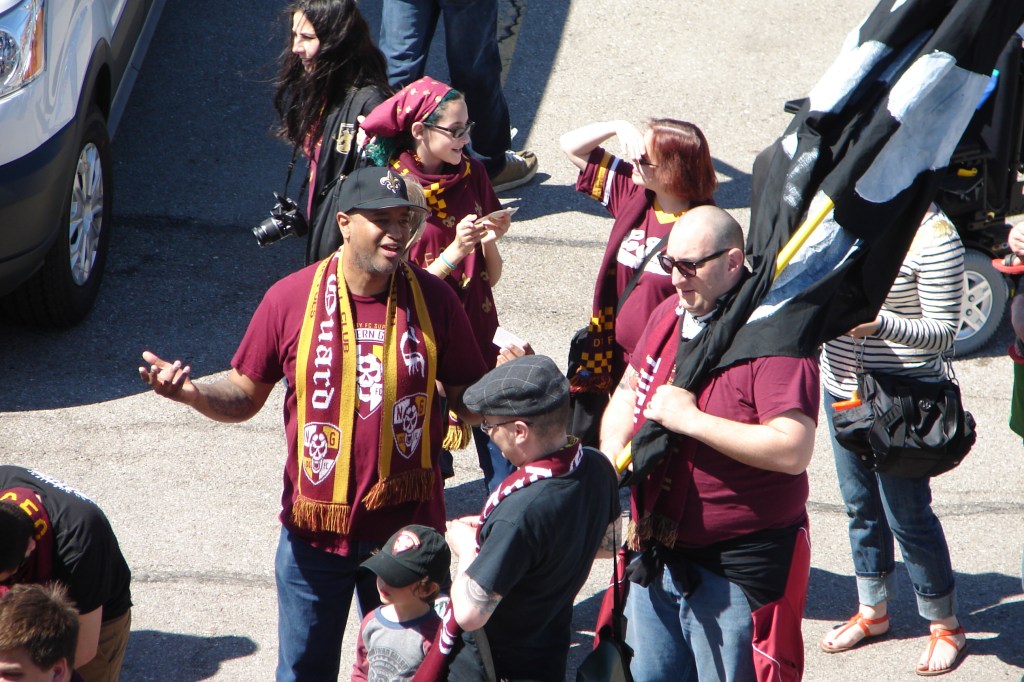
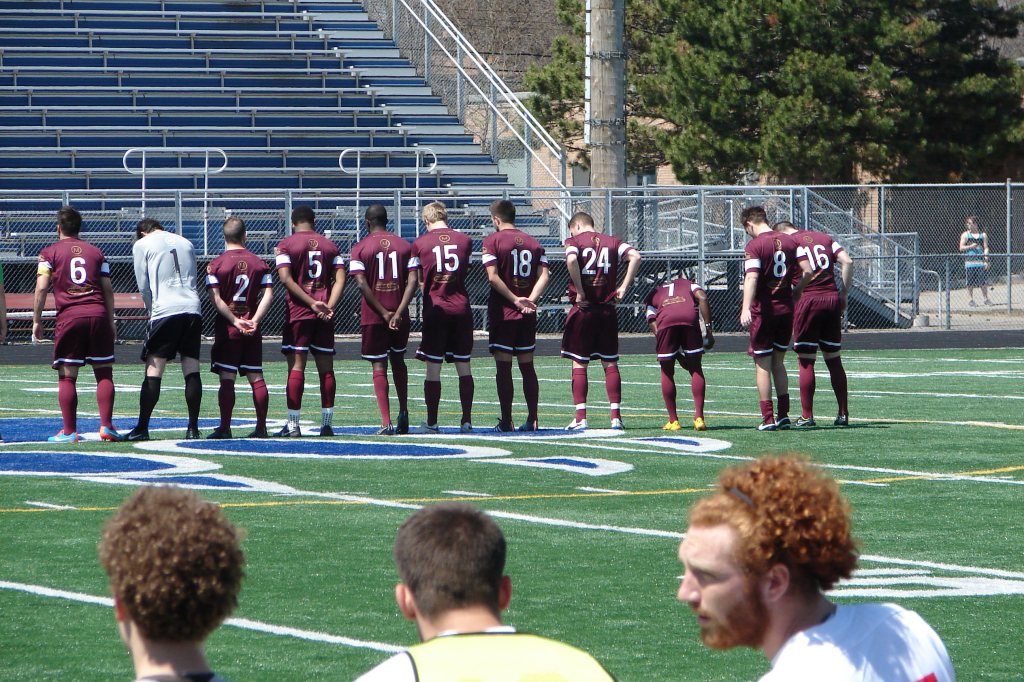
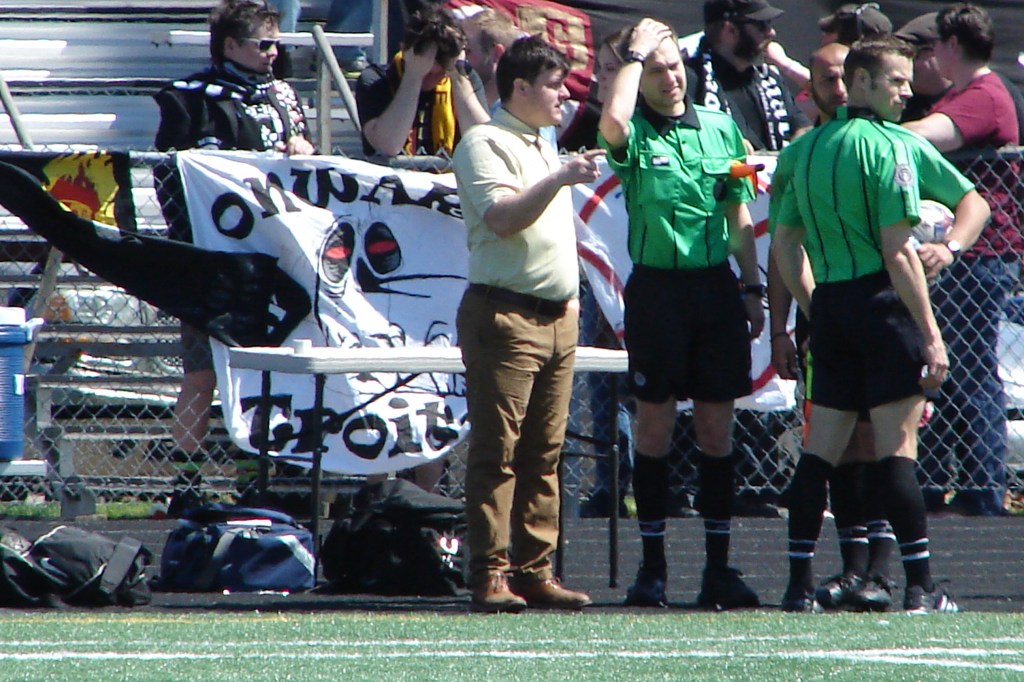
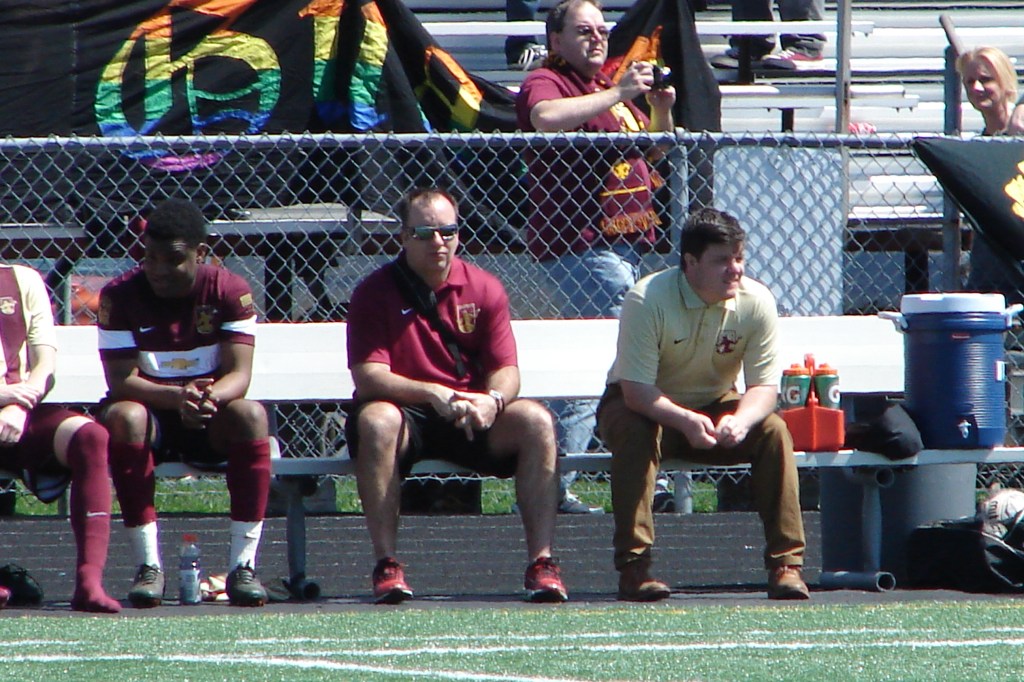
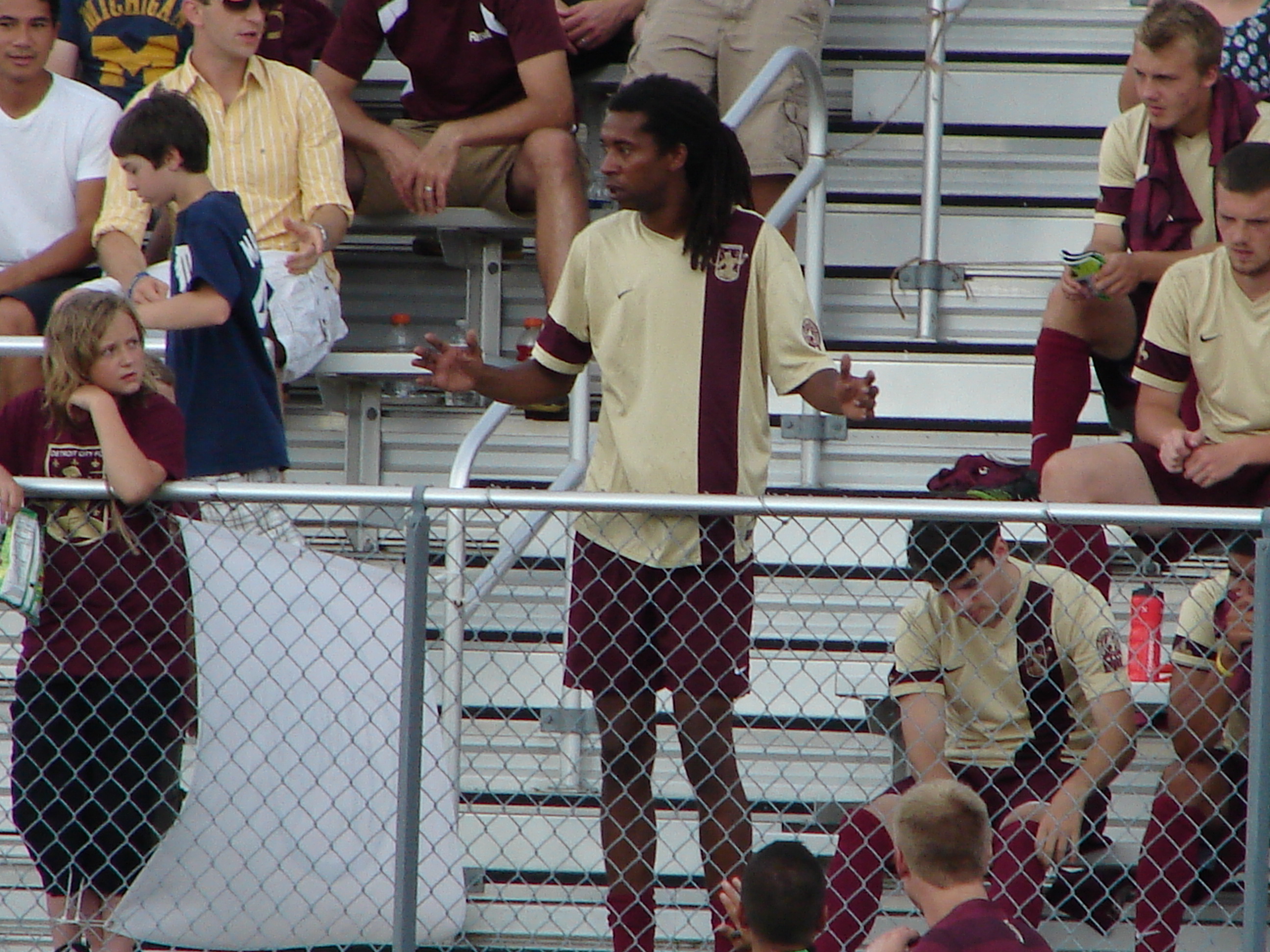
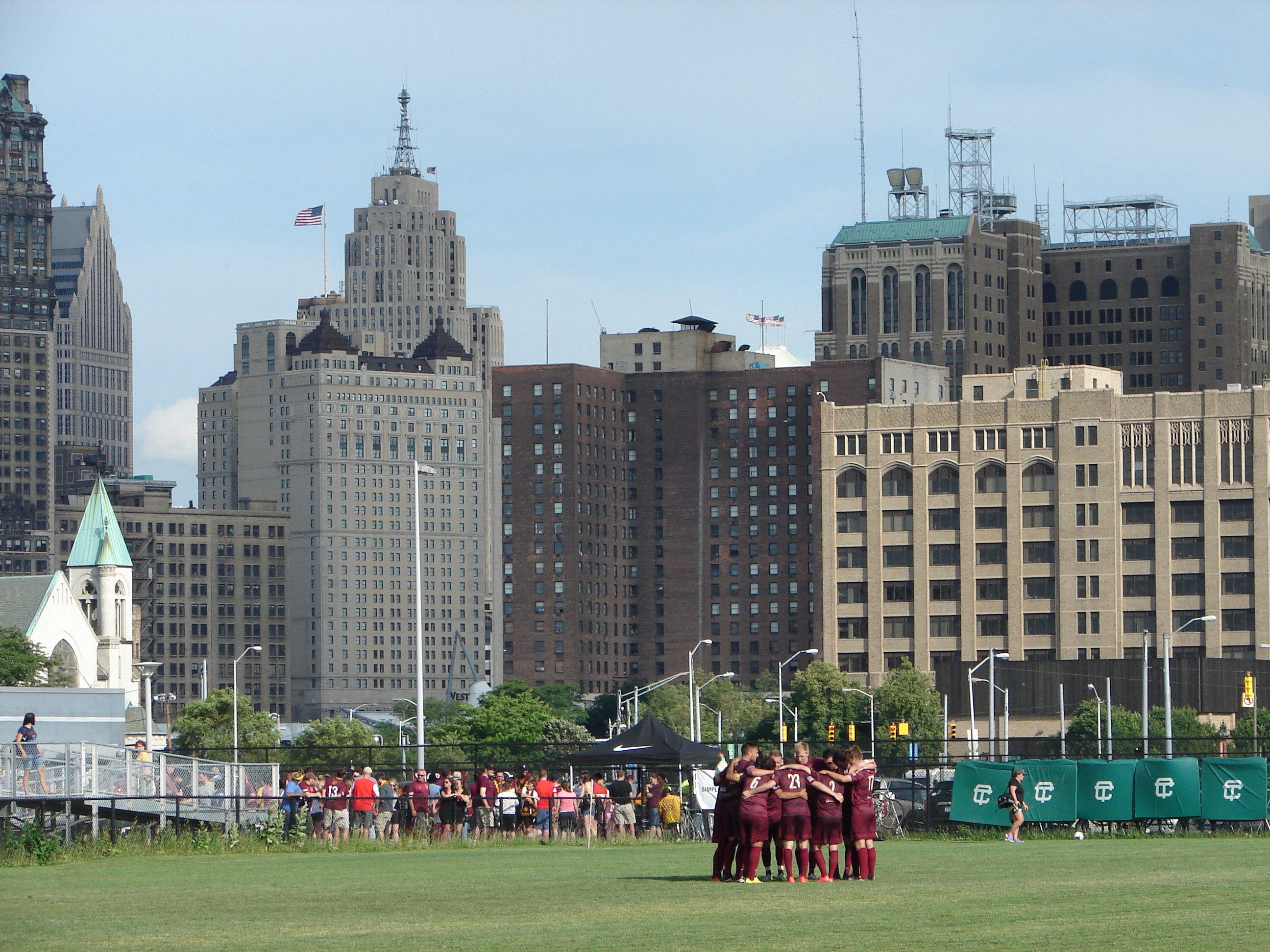
Another pre-season friendly to warm up the team, the supporters, and the photographers.






























































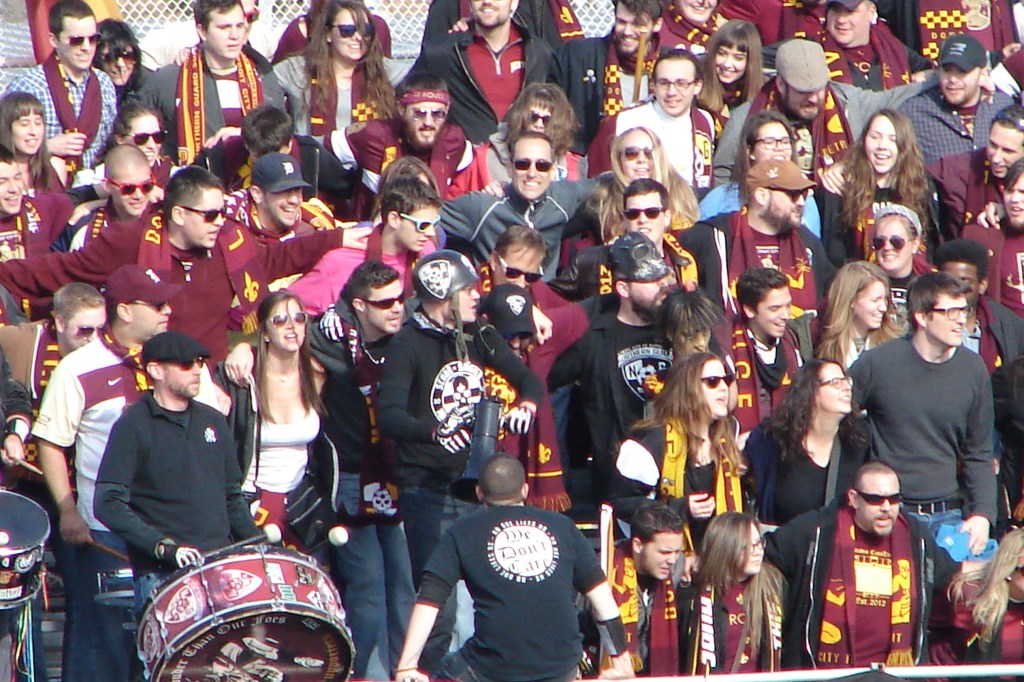



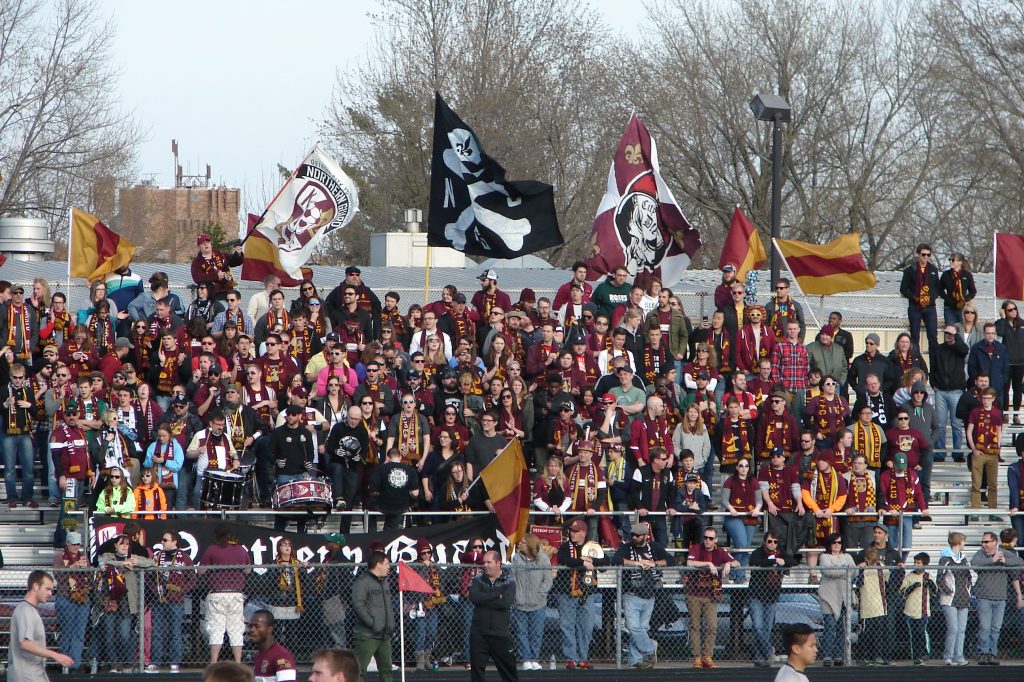








April 25, 2015
Friendly
Detroit City FC 0, Michigan State Spartans 1
Hurley Field, Berkley, MI
Attendance: 1,108
Another pre-season friendly to warm up the team, the supporters, and the photographers.

April 18, 2015
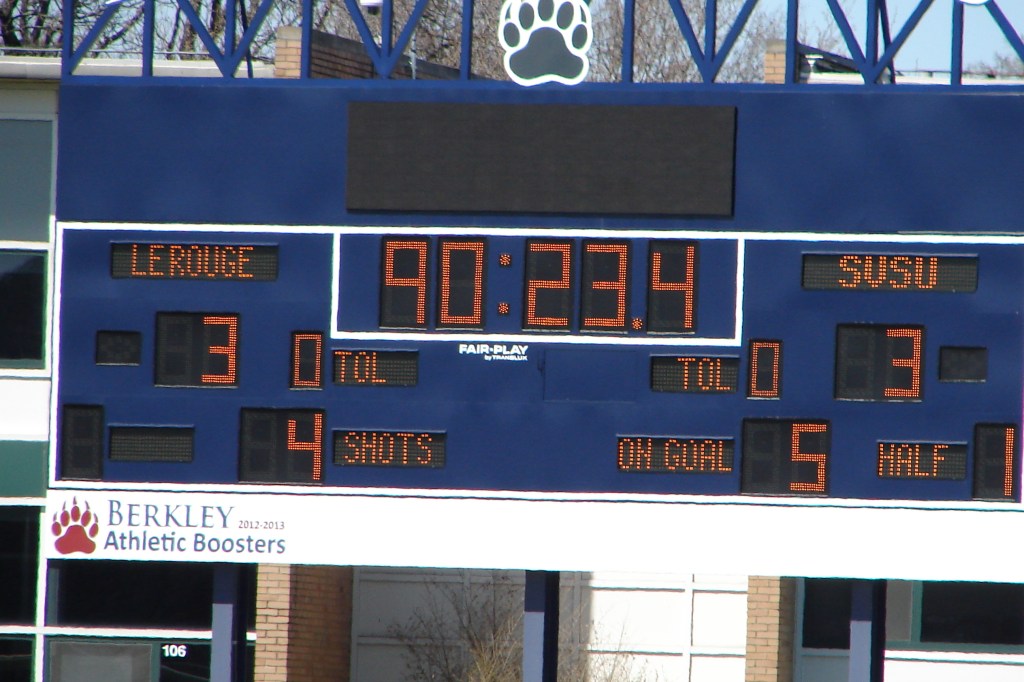
Detroit City FC 3, Saginaw Valley State University 3
Friendly at Hurley Field, Berkley, MI
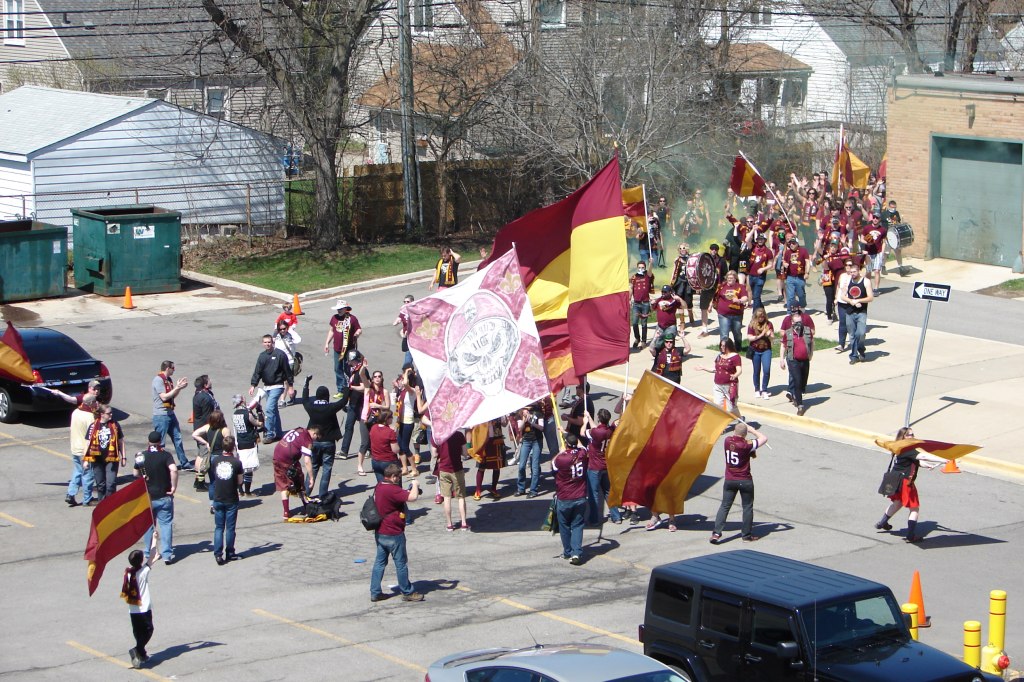
A new season. This was the first of three friendlies played prior to the much anticipated U.S. Open Cup match against the Michigan Bucks.
I didn’t jot down the goal scorers, as I focused on getting back into the pace of shooting the game, and chatted with fellow NGS members after the 188 days since last we saw each other at Cass. There were 1,012 fans in attendance, and four of the Saginaw Valley State University players in this match, found themselves wearing the Rouge and Gold during the 2015 season (Alexander Bouillennec, Troy Watson, Alex Isaevski, and Tyler Channell).




























































In July, 2014, I visited New York City for the first time. One day we spent book store shopping, during which we discovered Three Lives and Company in Greenwich Village. The small, well-stocked book store had a table upon which back issues of literary magazines were for sale for a couple bucks a piece. I picked up a copy of the Fall, 2012 edition of The Paris Review. This was my first exposure to the legendary literary journal founded in 1953 by a group of American writers including George Plimpton, Peter Matthiessen, Harold L. Humes, Thomas Guinzburg, and Donald Hall.
One of the stories within the 202’nd edition was Disgust by Ottessa Moshfegh. It opened with a 134-word paragraph which was a single sentence. I thought that was rather unconventional. No speakers or instructors at the writers conferences and workshops I’ve attended ever suggested that starting a short story with a 134-word sentence was a sure-fire way to get published. I suppose you can get away with being unconventional if your writing is strong, which Ms. Moshfegh’s certainly is. The protagonist in Disgust is the quirky, socially awkward Mr. Wu who has a crush on the woman who worked at the video game arcade, and his introverted schemes to make contact with her.
Upon returning home, I picked up the newest issue of The Paris Review, which was the 210’th edition – Fall, 2014. I’ve been hooked ever since.
The Winter, 2014, 211’th edition included another story by Ottessa Moshfegh. Slumming featured another quirky character, a high school English teacher who owned a summer home in Alna, a small town away from the city. She tells of her interaction with the residents, like Clark who she paid to maintain and watch the house during the school year, the zombies (vagrant townsfolk) who sold meth and heroin at the bus station, and the very pregnant girl who Clark paid to clean the narrator’s house. Again, the unusual characters drew me into the story.
In the September, 2015 Indie Next List flyer, Moshfegh’s debut novel, Eileen was promoted. I purchased it at Literati Bookstore in Ann Arbor, but I didn’t get a chance to read it until recently. In the interim, The Paris Review‘s 214’th, Fall, 2015 edition contained Moshfegh’s short story, Dancing in the Moonlight. The narrator, Nick, a Yale grad, falls for a woman selling her refurbished furniture in a pop-up market on the Lower East Side of New York, named Britt Wendt. “That’s not a name, that’s the beginning of a sentence,” his oldest friend, Mark Lasky said when he told him. Again, it was a well-crafted story involving unusual and engaging characters.
So here we are. My name was Eileen Dunlop. Now you know me. I was twenty-four years old and had a job that paid fifty-seven dollars a week as a kind of secretary at a private juvenile correctional facility for teenage boys. I think of it now as what it really was for all intents and purposes – a prison for children. I will call it Moorehead. Delvin Moorehead was a terrible landlord I had years later, and so to use his name for such a place feels appropriate.
In a week, I would run away from home and never go back. This is the story of how I disappeared.
Eileen is a novel-length exploration inside the head of yet another unusual character, in a reflection of the event fifty years prior, in 1964, that caused her to run away from home. As a result of her disappearance, Moshfegh’s narrator changed her identity , and masks the details of the New England town in which she was born, raised, and fled from.
Darkly funny and sad, Eileen lives with her father – a retired police officer – whose reputation keeps him from finding himself in jail from his drunken antics when he wanders from home. Her mother had recently died, and her older sister, Joanie, lived with another man a few towns over, leaving Eileen to care for her unappreciative, intoxicated father.
Eileen was a social outcast, and the inner workings of her mind are creepily realistic. The reader is placed in a position of feeling both uncomfortable and pity for the girl. She thinks about leaving, about how her father, her sister, her co-workers, might feel if she were suddenly gone, but nothing moves her. Until the correctional facility hired a new counselor – Rebecca St. John.
Rebecca is an educated, classier woman who is new to town and becomes friendly with Eileen. This sparks a glimmer of hope for the narrator, a companion and friend. Rebecca becomes the catalyst for Eileen’s disappearance.
Throughout the novel, the reader knows that something is going to happen to cause Eileen to leave town. The ‘why’ she leaves, well, I did not see coming.
Like her three previously published short stories, Ottessa Moshfegh pulled me into the company of an unusual character, the kind of character I prefer to read about, and weaved a satisfying story within a gloomy environment in Eileen.
On Goodreads, I rated this novel a 4 out of 5. I really liked it.
July 23, 2014
Detroit City FC 0, Windsor Stars 0
Attendance: 3,020
September 13, 2014
Detroit City FC 2, Ann Arbor United 2
Cass Tech HS 5, Detroit Renaissance 2
Attendance: ?
Sorry to disappoint with this one. I attended both matches, but my camera did not.
In the friendly against Windsor, my camera stayed home, packed for our trip to New York City. We left the next morning for our long drive and my first venture into the Big Apple, but it had a soccer component as well. Among our site-seeing, we attended the friendly between Arsenal and the New York Red Bulls on July 26th at Red Bull Arena (NYRB 1, Arsenal 0)…




…followed by a match between Liverpool and Manchester City at Yankee Stadium on July 30th (2-2, with Liverpool winning on PKs 3-1).



The Windsor game was just a fun evening of hanging out with the Northern Guard, flavoring my outerwear with sulfur.
The September 13th game, however, was significantly different.
This was the first Detroit Public Schools Showcase which featured a friendly between Detroit City FC and Ann Arbor FC in the first match, followed by a league game for Cass Tech High School and Detroit Renaissance High School. It was a fundraiser for the high school program, which did not exist until after Detroit City FC’s emergence in 2012.
In April of 2014, we purchased a house that also had a one-bedroom, mother-in-law cottage on the property, in which my mother-in-law, Shirley Willard, had moved into. Physically she was not getting around well, having had both knees and hips replaced in the previous years. In August she took ill. She had had breast cancer which had gone into remission a number of years ago. It returned with a vengeance. Home-care nurses were visiting regularly, oxygen tanks were being utilized and replenished.
Two days before the match, she was admitted into the hospital in the morning, and by evening was moved to hospice. My wife, daughter, and son, along with my brother-in-law, stayed the next night at her side. She passed as the sun rose match-day morning. With everyone crashing after the long night, I went down to the game, leaving the camera at home.
Since the growth of this team, I have become Facebook friends with so many Northern Guard Supporters. This match, I met a lot of them in person. Prior to going down to the game, I posted a comment on my timeline about Shirley’s death. I didn’t realize how much I would be embraced throughout the night. It was this game that I experienced the difference between “season ticket holders” and “supporters.” You can have season tickets for a team, sit next to people regularly at the game, and know little or nothing about their lives. Being a part of a supporters group, however, is not solely to support the team. It’s about supporting each other in our lives outside the team; to cheer the successes, to help with personal goals, provide advice/assistance when possible, and to console each others’ pain. Are there differences of opinions and beliefs and even in being fans of different MLS and European teams among such a large group? Of course there is. But despite these differences, this team…this fourth-tier football club…is what draws us together, pumping our hearts with rouge-and-gold blood, creating a common bond that goes beyond sitting in a stadium for a few hours next to each other.



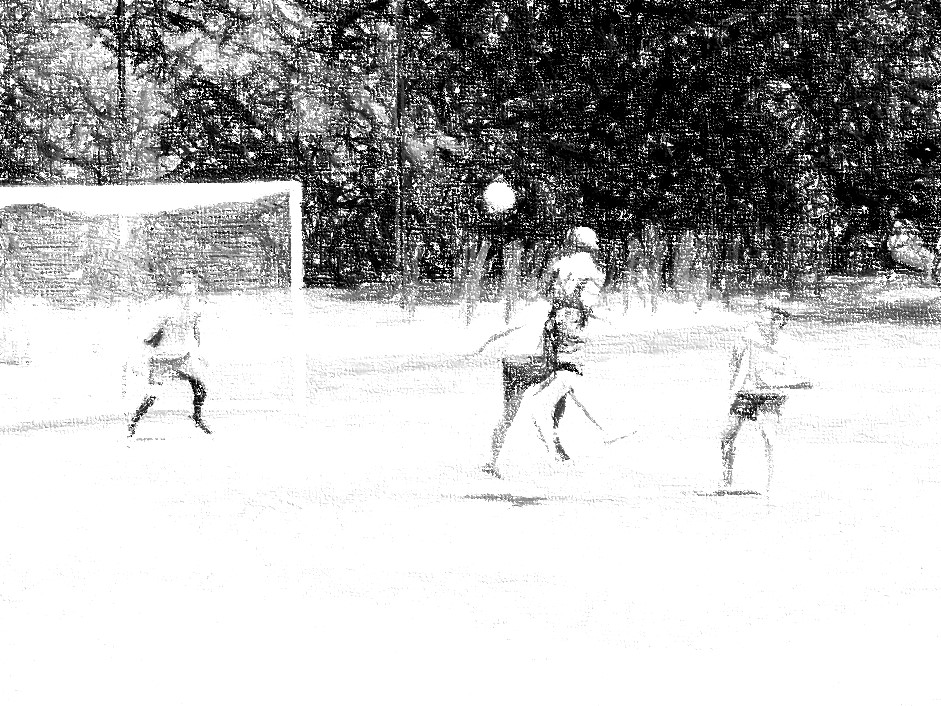
July 13, 2014
Detroit City FC 2, Lansing United 2
LANS Matt Brown (Brian Cunningham) 20′
DCFC Josh Rogers (PK) 37′
LANS Gabe Mateo 66′
DCFC Locky Savage 94′
The final regular season game for both teams had playoff implications. Going into the Sunday afternoon affair, Lansing (8 wins, 3 draws, 2 losses = 27 points) had a one point lead over Le Rouge (8 wins, 2 draws, 3 losses = 26 points) for first place. Due to the NPSL braintrusts’ plans, only the first place team in the Great Lakes Conference would advance to the Midwest Regional Division playoffs. A win for either team would crown them Conference champions. A draw would give the title and playoff spot to Lansing.
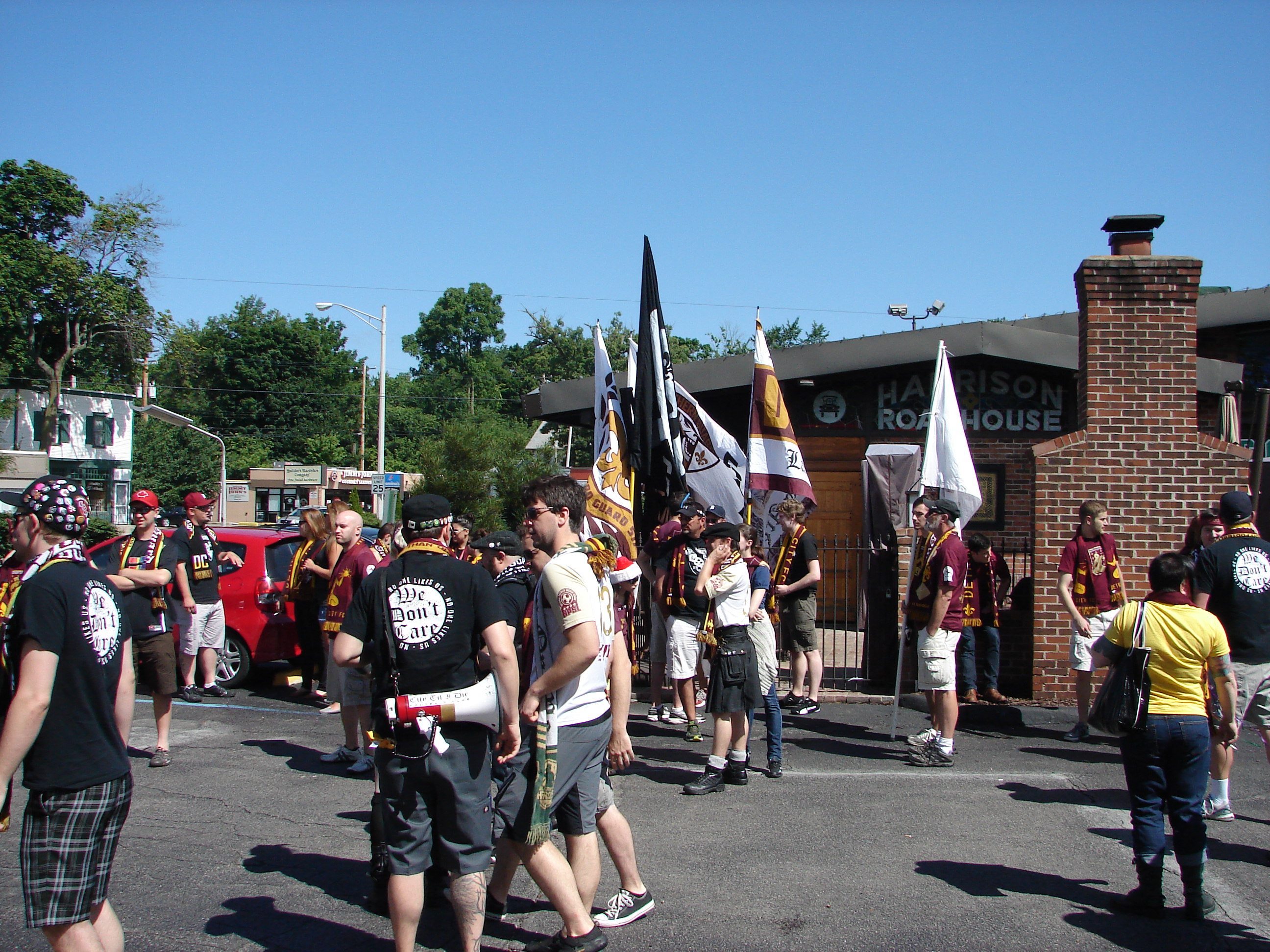
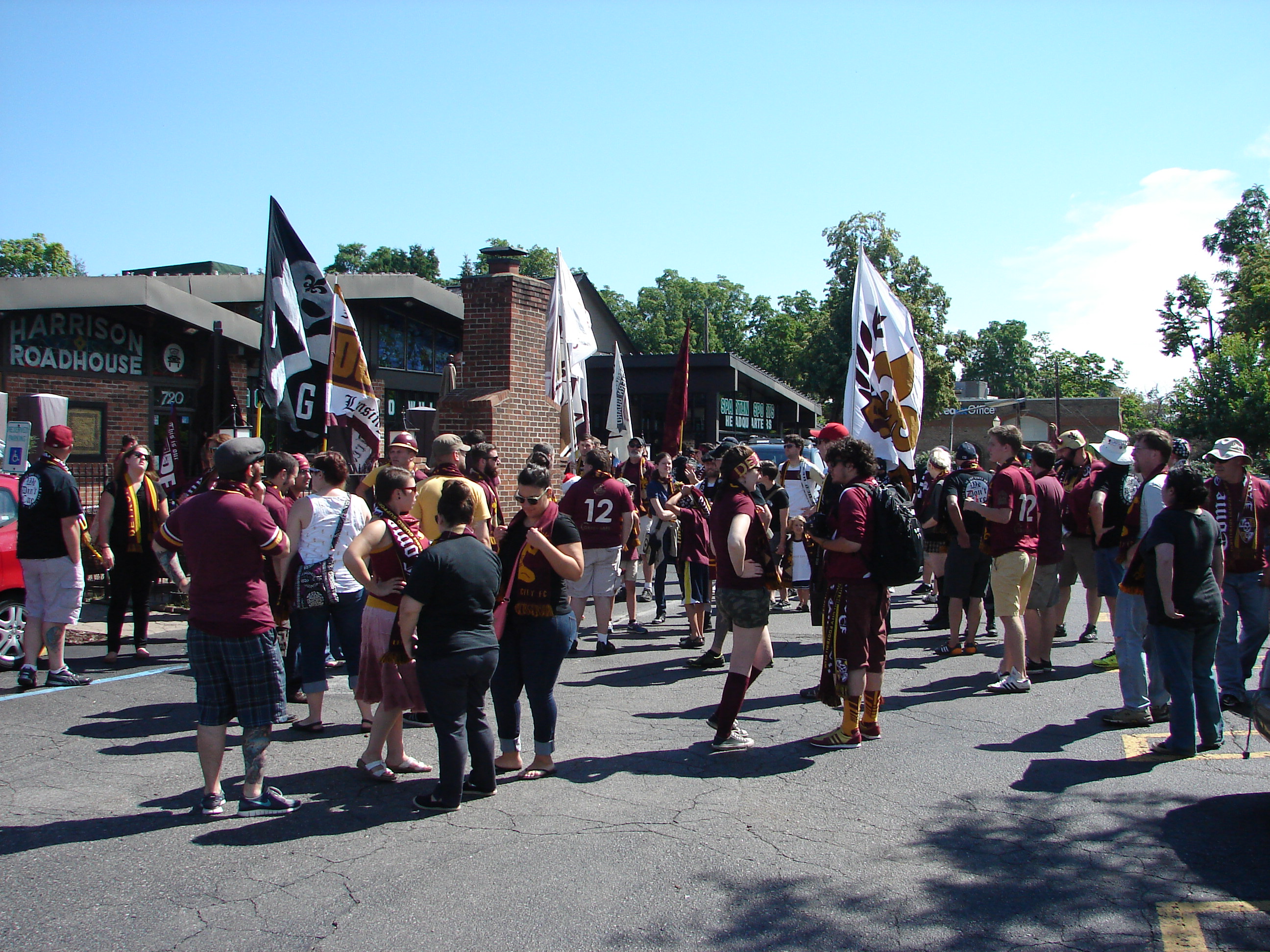
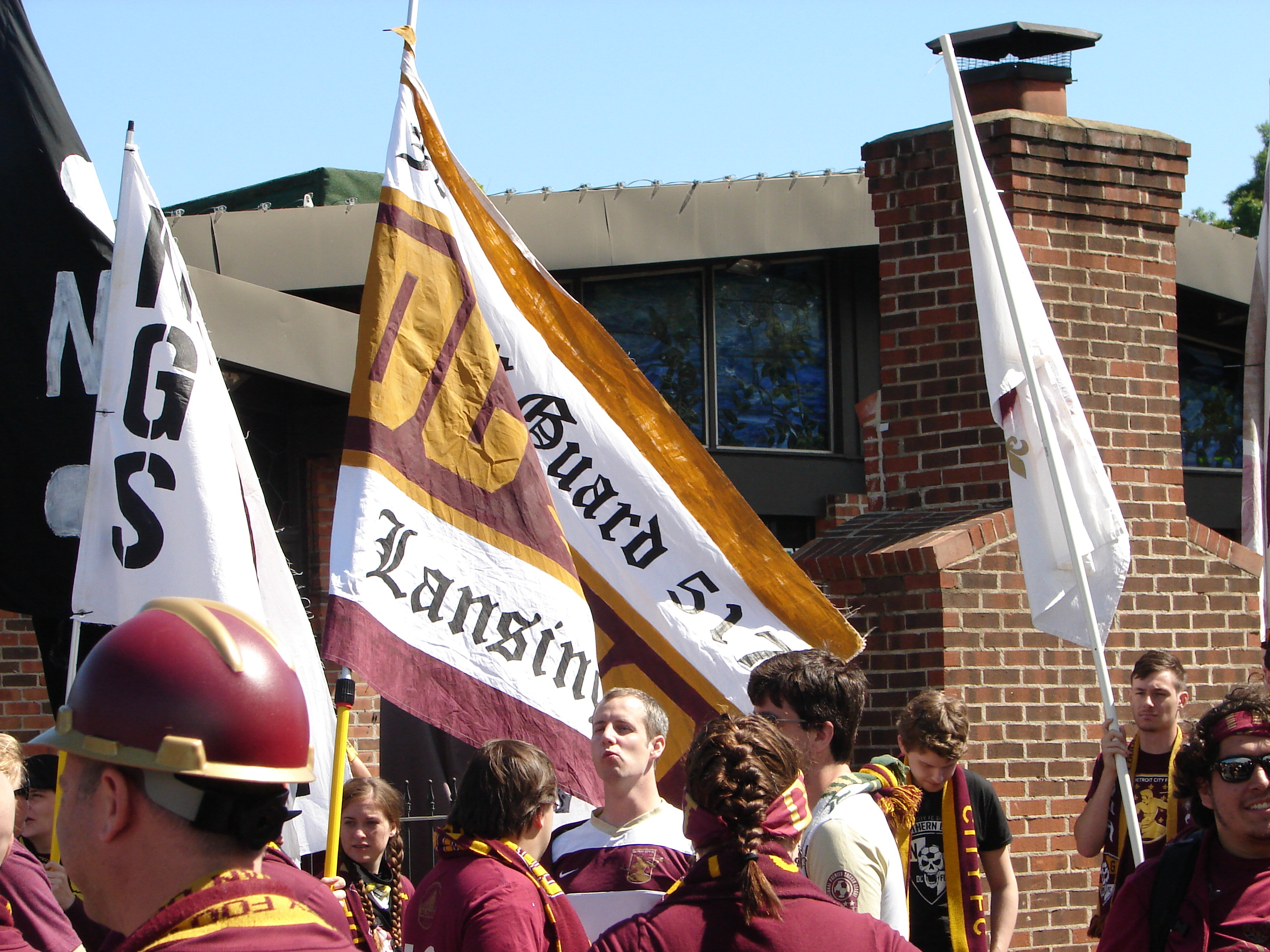
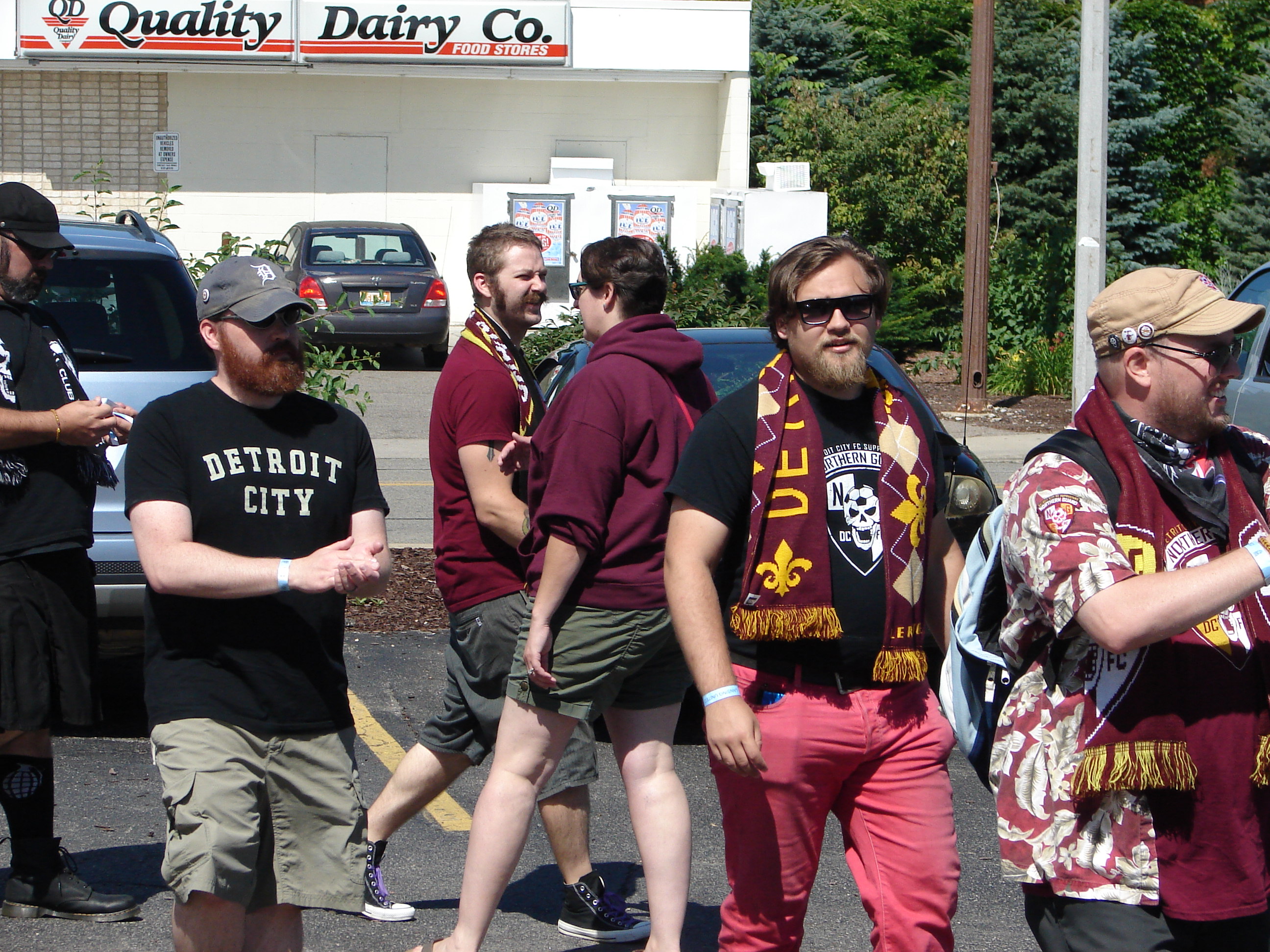
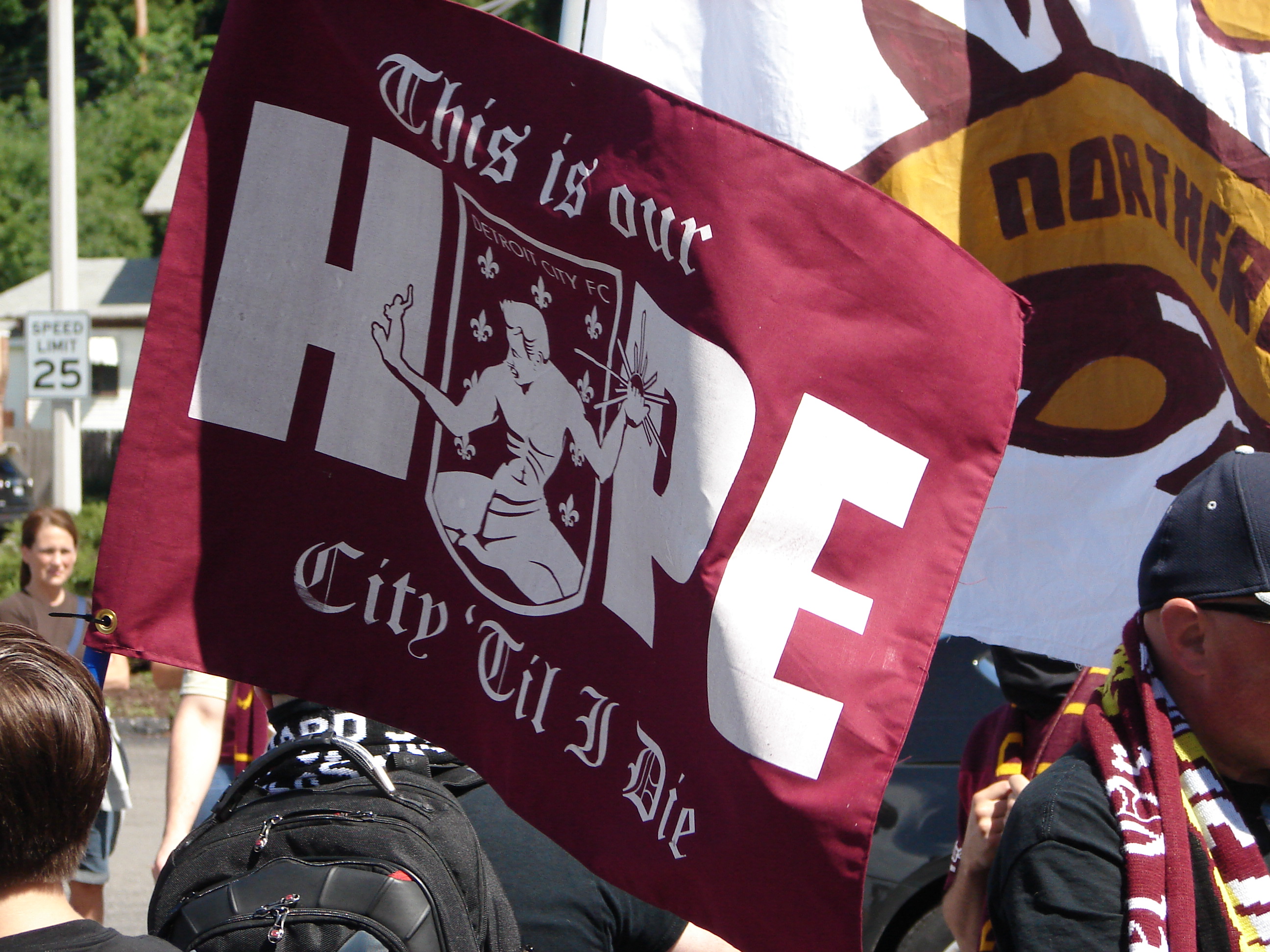
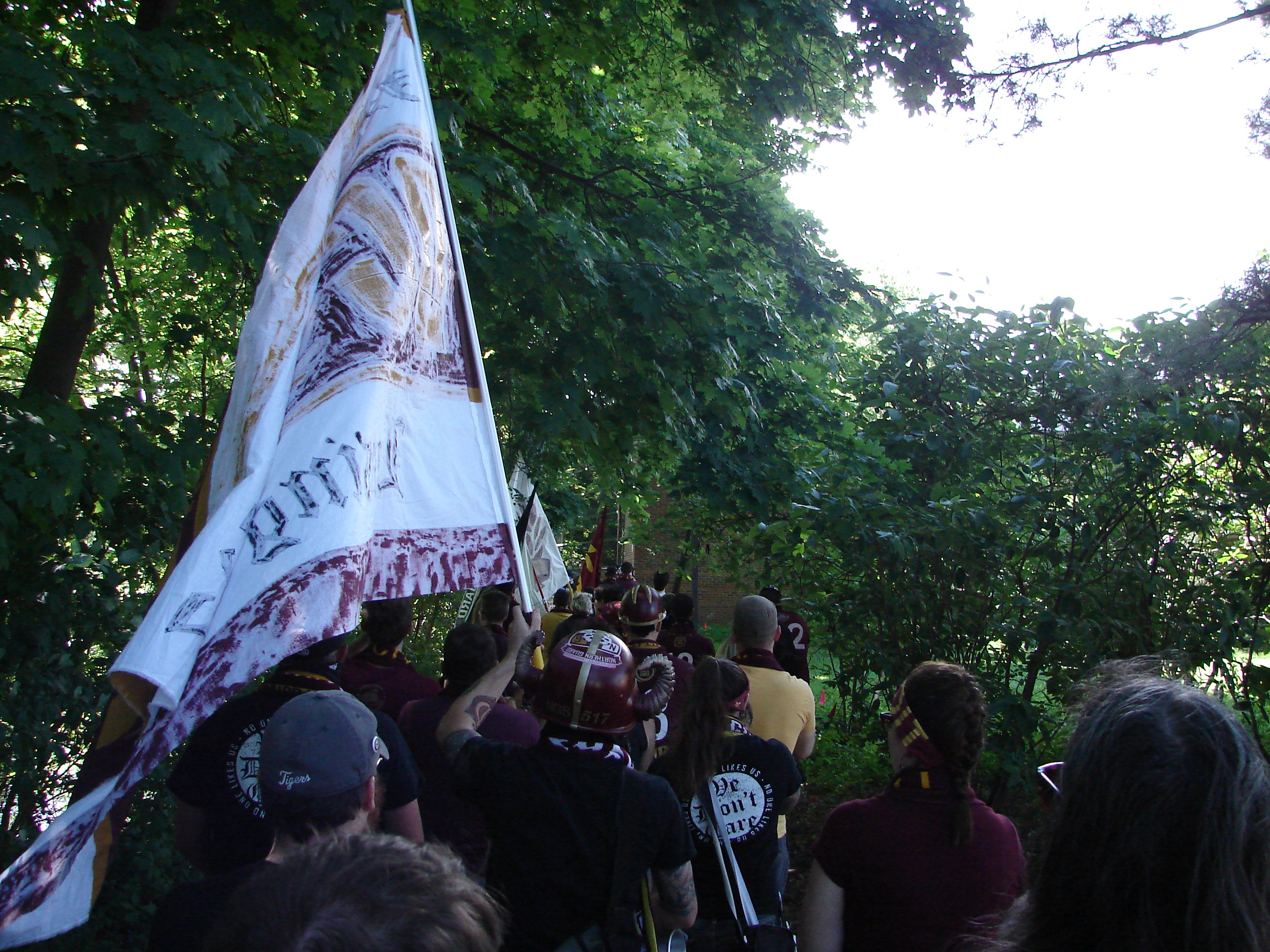
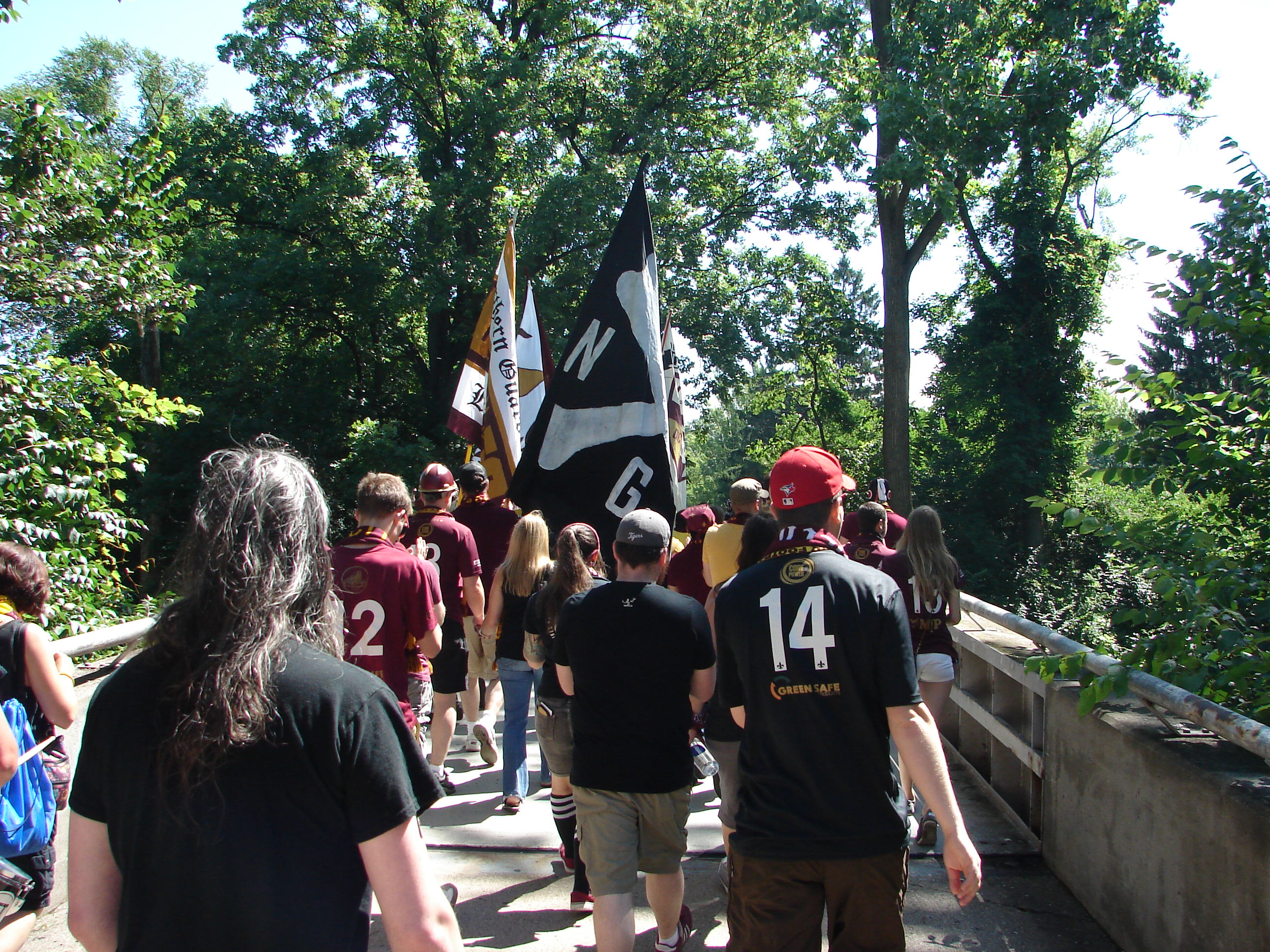
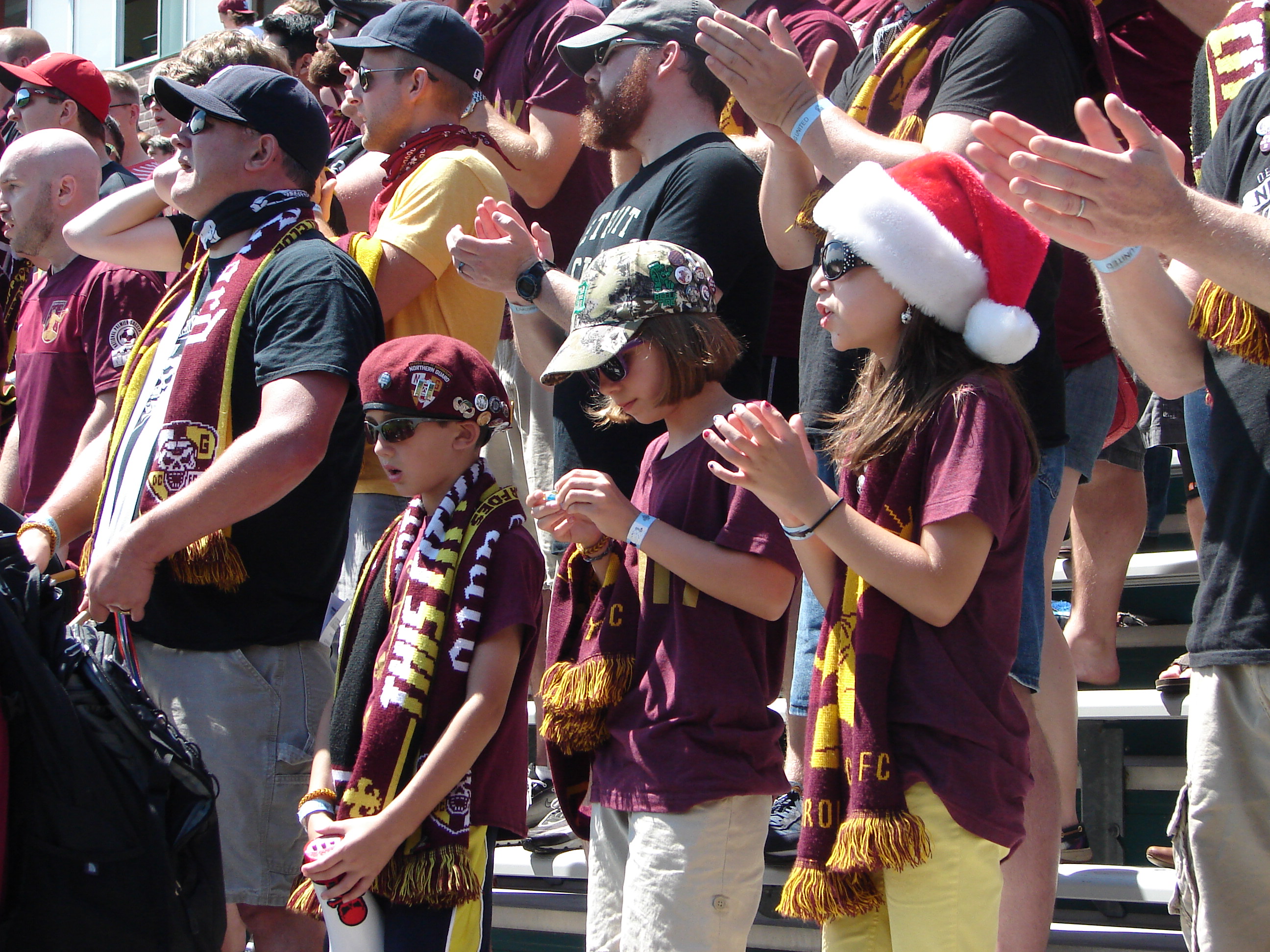
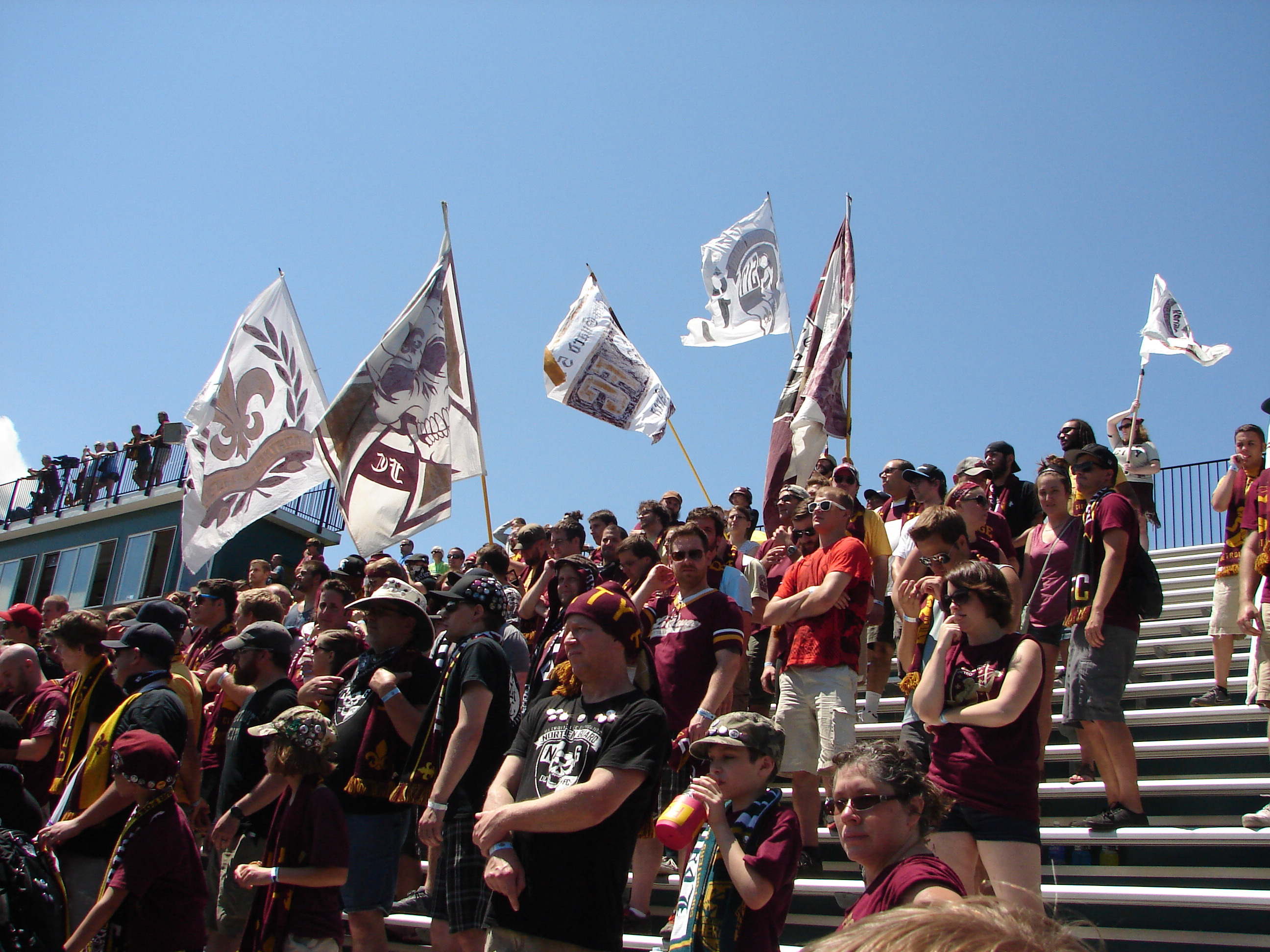
We met at Harrison Roadhouse for the breakfast buffet, out-shouting the couple of tables of “Sons of Ransom” supporters, then marched to DeMartin Stadium, home of the MSU Spartan soccer team. The announced attendance trickled over the two-thousand mark, but we accounted for a significant portion of that. We were not in the majority of bodies in the stands, but we certainly were the loudest.
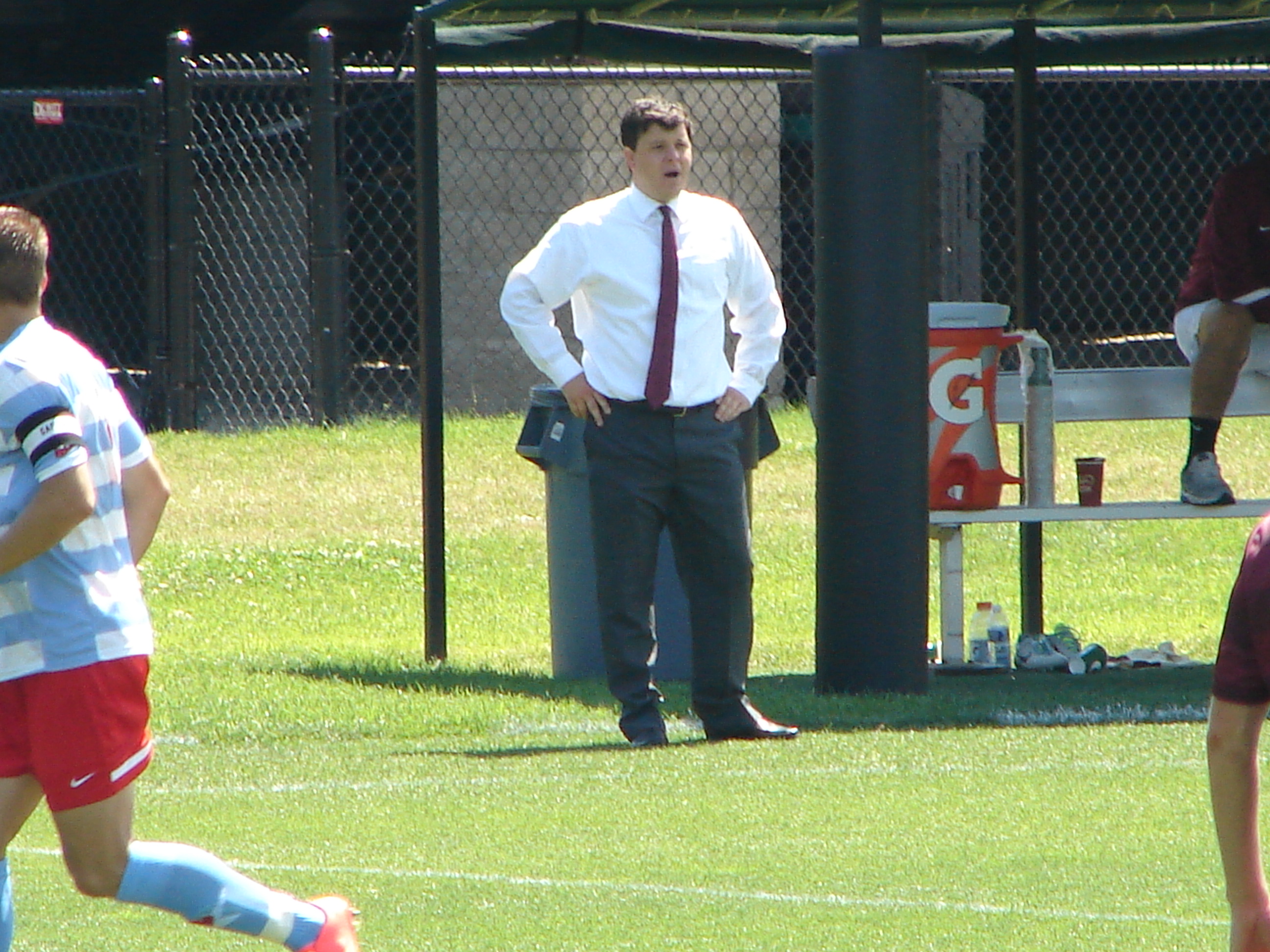
Lansing opened the scoring in the 19th minute when Matt Brown headed in a pass from Brian Cunningham. Le Rouge equalized in the 36th minute when Zach Myers was taken down in the box and Josh Rogers converted on the penalty kick. The halftime 1-1 draw favored Lansing.
In the second half, Gabe Mateo broke free and scored in the 66th minute to give Lansing the lead. Detroit pressed the rest of the game, managing to tie it on Locky Savage’s goal in the waning moments of stoppage time.
It was heart-breaking, yes, but they stayed and chanted and sung as the rest of the fans emptied the stadium. Le Rouge players then joined the Northern Guard Supporters for a final hurrah.
Pre-Game























Action









































July 11, 2014
Detroit City FC 3, Fort Pitt Regiment 1
PITT Lamine Balde (Michael Tuohy) 26′
DCFC Latif Alashe 56′
DCFC Shawn Lawson (T.J. Van Slooten) 72′
DCFC T.J. Van Slooten 90′
Attendance: 3,398
The team’s first sell-out and new attendance record with 400 or so folks turned away at the gate. Fort Pitt considered ruining the party and final home game of the season for Le Rouge when Lamine Balde scored in the 25th minute. They took the 1-0 lead with them into the locker room at half time.
The second half was completely different.
Latif Alashe scored in a goal-mouth scramble in the 56th minute to level the score. Then, Shawn Lawson scored the prettiest goal of the season and probably in the history of Detroit City FC, carving through a couple of defenders and the keeper for the highlight reel game-winning tally in the 72nd minute. T. J. Van Slooten scored in added time to hammer the final nail in the Fort Pitt casket.
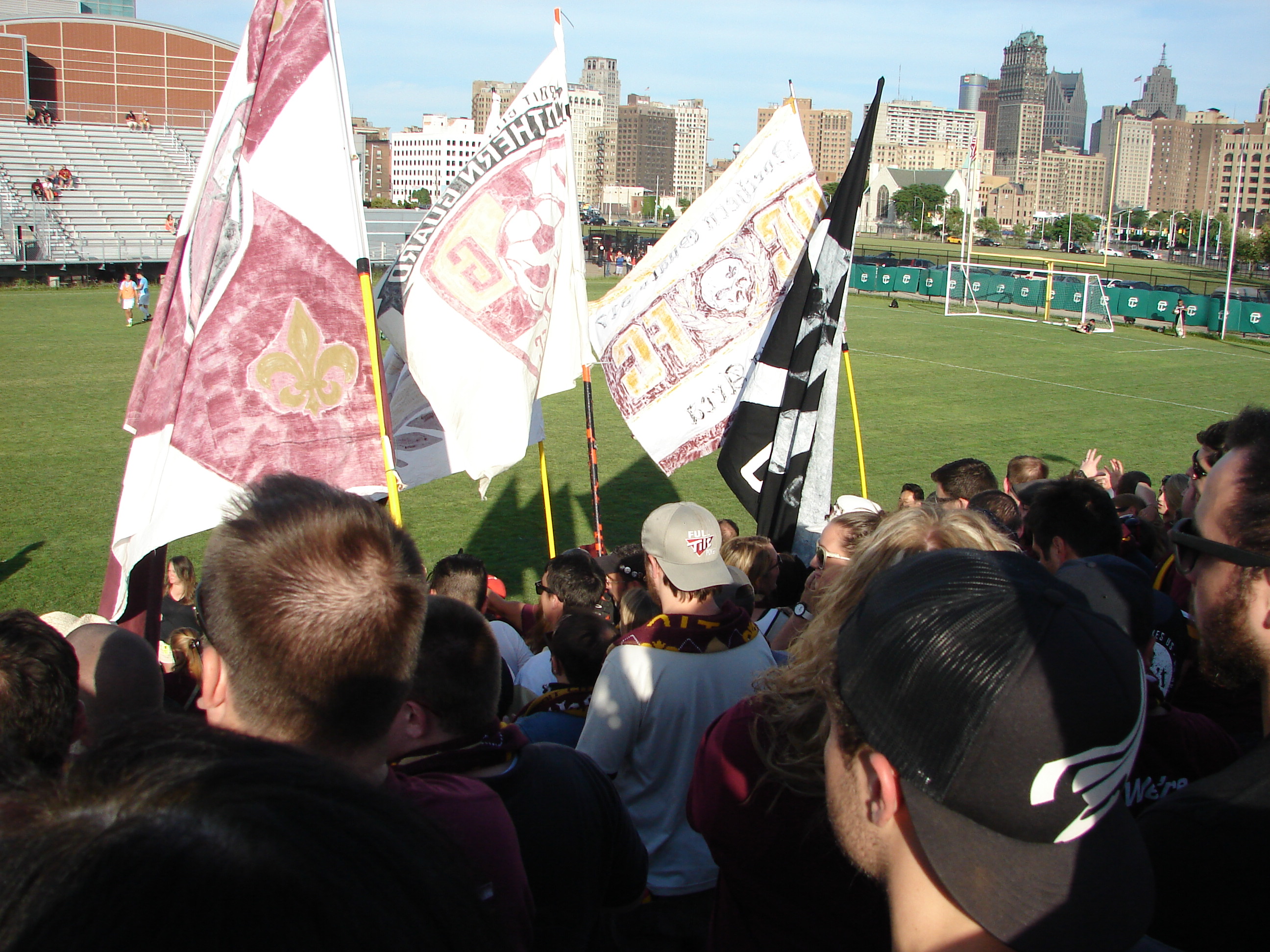
The video I shot at this match is on another page titled “90 Minutes Within the Northern Guard Supporters Section,” where I wanted to capture the experience of reveling with the rabid supporters of Detroit’s soccer team.
Pre-Game












Action






















July 6, 2014
Detroit City FC 2, Cincinnati Saints 0
DCFC Jeff Adkins (William Mellors-Blair) 9′
DCFC William Mellors-Blair (Jeff Adkins) 59′
Attendance: 2,612
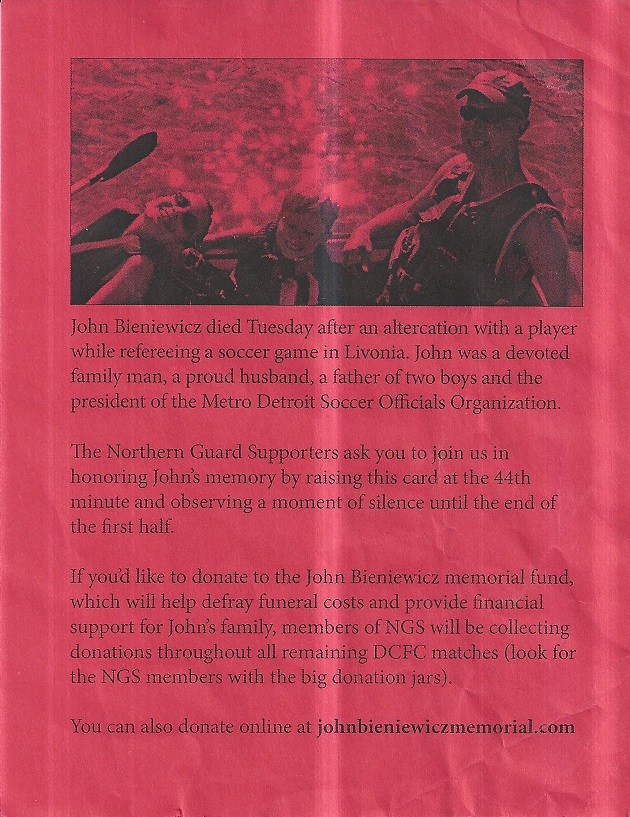
Days prior to this match, the Metro Detroit soccer community suffered a tragedy. John Bieniewicz was about to red card a player while refereeing a match in Livonia when he was blindsided with a punch by the player, ultimately ending the life of the referee. Bieniewicz, the president of the Metro Detroit Soccer Officials Organization, was a 44-year-old husband and father of two boys. The incident shook the community.
To honor the life of John Bieniewicz, the Northern Guard Supporters created these “red cards” that were to be raised by all in silence in the 44th minute of the match.






As for the game, of course City pummeled the Saints into submission once more. That’s what we do.
The Kitchen/DCFC vs Bruce/Saints rivalry is once again absent any member of the Bruce family. Fearful, they are, of treading onto City grounds. One begins to question whether a rivalry really exists, especially when one team is Le Rouge, and the other team sucks so bad that its hometown fans distance themselves from the team.
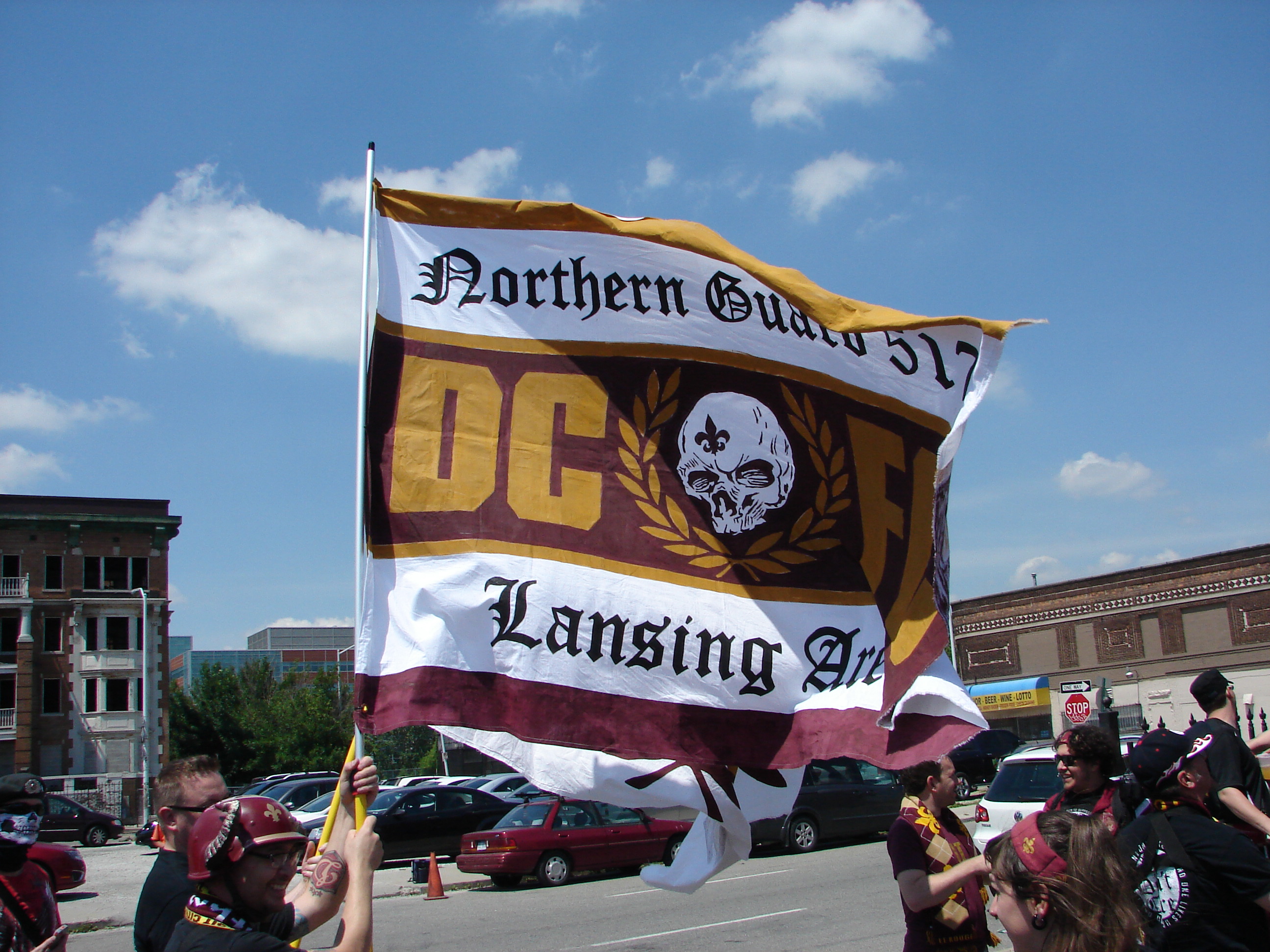
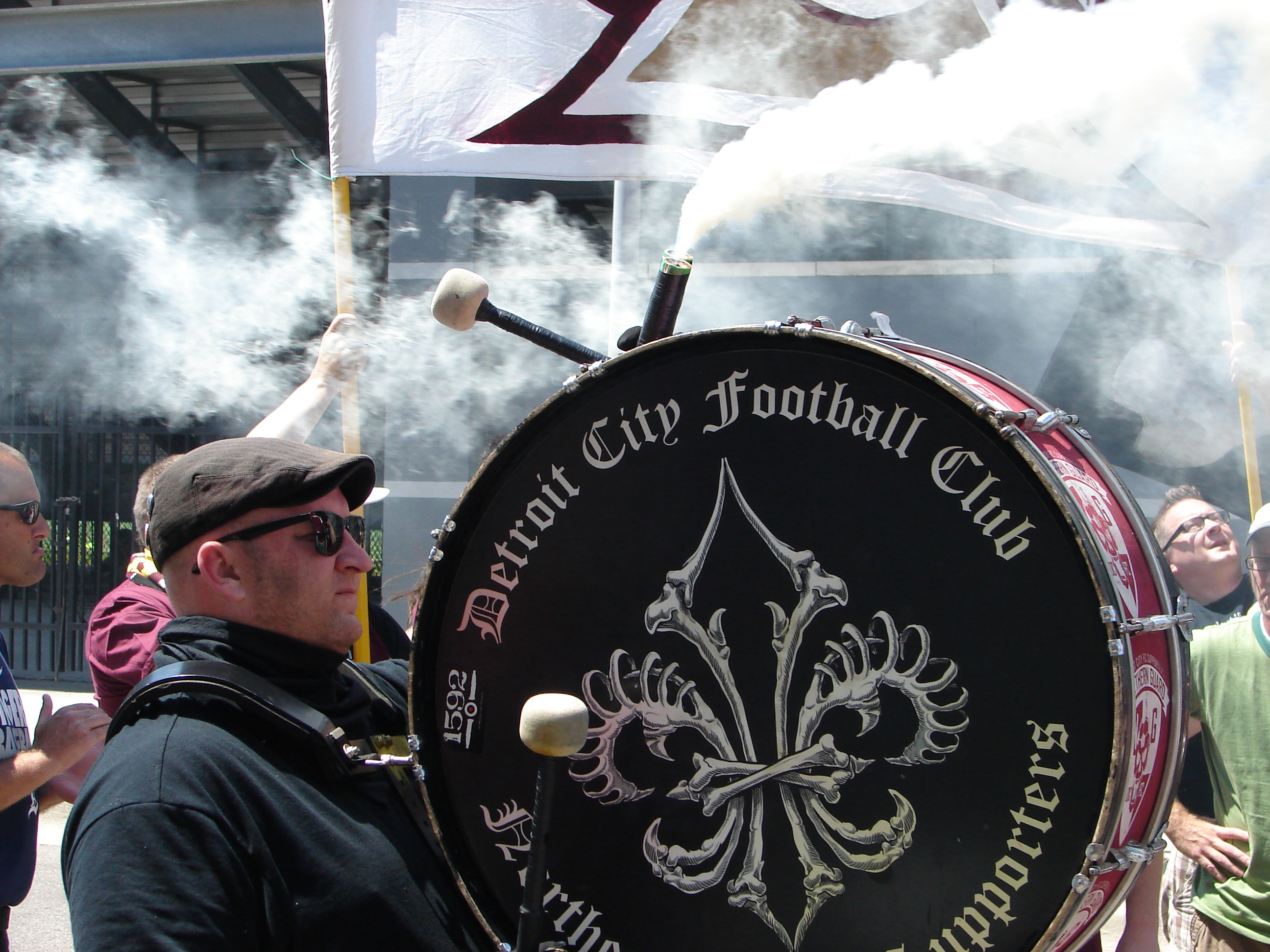
Pre-Game

















Action









































December 31, 2015. What are my goals for the New Year? None!
For a period in my life I swam in the waters of “positive thinking”; of goal-setting with the focus on living in prosperity. I read the books and listened to the cassettes, and attended a church that was infused with what Oliver Burkeman in his book, The Antidote: Happiness for People who can’t stand Positive Thinking (Faber & Faber, Inc. 2012), called the “cult of optimism.” Since 1991 I drafted and tracked goals on a semi-annual basis. Some goals were accomplished, others not, and others abandoned because my heart was never into them when I first committed them to paper. I stopped after 2001 because life was traveling at a dizzying pace.
Goal setting creates a mindset that you’re not “happy” or “good enough” or “successful” in the present moment. So you set a goal for a future event that will define you or your work as a success, and thus delay happiness to that point. To quote Ambrose Bierce’s The Devil’s Dictionary, the future is defined as “(t)hat period of time in which our affairs prosper, our friends are true and our happiness assured.”
In the chapter titled “Goal Crazy: When Trying to Control the Future Doesn’t Work,” Burkeman demonstrated how goal setting backfires with, in some cases, deadly consequences, such as a 1996 Mount Everest climb that took the lives of eight people. Chris Kayes, a former stockbroker who became an expert on organizational behavior and was one of the surviving climbers, links the deaths to goal-setting, as they were “lured into destruction by their passion for goals.” (Burkeman, pg. 78). “In theology, the term ‘theodicy’ refers to the effort to maintain a belief in a benevolent god, despite the prevalence of evil in the world; the phrase is occasionally used to describe the effort to maintain any belief in the face of contradictory evidence. Borrowing that language, Chris Kayes termed the syndrome he identified as ‘goalodicy.'” (Burkeman, pg. 78-79). In Kayes’ studies of business organizations and their goals, he found that when a business’ goal was not being met, the business put forth a larger investment in effort and resources to pursue the goal, resulting in making the chance of accomplishment worse. (Burkeman, pg. 79).
Burkeman also sites a study that shows that those motivated by a goal are more apt to cheat. There are big name positive-thinking gurus who site the Yale Study of Goals. A group of researchers found that 3% of the students of the 1953 graduating class of Yale University formulated specific, written goals for their lives. The researchers returned twenty years later and allegedly found that those students amassed greater financial wealth than the other 97% combined. Compelling, eh? That’s why so many motivational gurus cite it. The problem is, the study does not exist.
Goals are more of a hindrance to living a happy life than not. In a survey commissioned by Steve Shapiro, 41% of adults agreed that achieving their goals had failed to make them happy, or had left them disillusioned, while 18% said their goals had destroyed a friendship, a marriage, or other significant relationship. Steve Shaprio, Goal-free Living (Hoboken, New Hersey: Wiley, 2006) cited by Burkeman.
Seriously. It can’t be said any clearer than this:
The optimism-focused, goal-fixated, positive-thinking approach to happiness is exactly the kind of thing the ego loves. Positive thinking is all about identifying with your thoughts, rather than disidentifying from them. And the ‘cult of optimism’ is all about looking forward to a happy or successful future, thereby reinforcing the message that happiness belongs to some other time than now. Schemes and plans for making things better fuel our dissatisfaction with the only place where happiness can ever be found – the present. ‘The important thing,’ (Eckhart) Tolle told me, ‘is not to be continuously lost in this mental projection away from now. Most humans are never fully present in the now, because unconsciously they believe that the next moment must be more important than this one. But then you miss your whole life, which is never not now.’ Another staccato chuckle. ‘And that’s a revelation for some people. To realize that your whole life is only ever now. Many people suddenly realize that they have lived most of their life as if this were not true – as if the opposite were true.’ Without noticing we’re doing it, we treat the future as intrinsically more valuable than the present. And yet the future never seems to arrive. Oliver Burkeman, The Antidote: Happiness for People Who Can’t Stand Positive Thinking (Faber and Faber, Inc. 2012) p.116.
After graduating from law school in 2004, and prior to studying for the Bar, I revisited my goal setting process. The process was superficial and empty to me due to my deeper practice and study of Zen during the break from goal-setting. In re-reading the entries from the twice-a-year logging of goals achieved, shelved, and committed to, I found that there was a lack of satisfaction. There were some things that created great memories. But it felt like an unending checklist that, once some goal was achieved, there had to be something else to replace it. And worse, concepts like being “prosperous” or “intelligent” or “wealthy” or “something better” lacked substance. What is wealthy? When does “wealthy” become achieved? It was like the hungry ghosts of Buddhist teachings, where the ghosts’ mouths are so small, yet their hungry bellies are so large, that no amount of “wealth” or “prosperity” or “intelligence” will be enough to fill them.
I sought to reconcile this and came upon a talk by Sangharakshita called “Nirvana” In the talk, Sangharakshita discusses “The Psychology of Goal-setting,” which can be found in the Essential Sangharakshita: A Half-Century of Writings from the Founder of the Friends of the Western Buddhist Order by Urgyen Sanharakshita (Wisdom Publications, 2009). He describes a goal as something that you strive for.
“You could, if you like, draw a distinction between striving to be and striving to have. But actually, the two come to the same thing: ‘having’ is a sort of vicarious ‘being.’ A goal is in the end something that you want to be.” (Sangharakshita, pg. 116).
This makes sense to those who have goals of being wealthy, or being intelligent. Then, Sangharakshita takes it to the next step.
“There is one really crucial (if obvious) precondition for setting a goal: it must represent something you aren’t. You don’t want to have or to be what you already are. You can only want to be what you aren’t – which suggests, obviously, that you’re dissatisfied with what you are. If you’re not dissatisfied with what you are, you will never strive to be what you aren’t.” (Sangharakshita, pg. 116).
This dissatisfaction ultimately is a desire to achieve happiness. No one seeks unhappiness. And these concepts of “prosperity” or “intelligence” or “appreciated” or “respected” are never ultimately achieved. Why? Because at any level, there will be a need to be more prosperous, or more intelligent or more appreciated or more respected, or for something better. They are the empty bellies of hungry ghosts.
What does Sangharakshita suggest is the fix to this? A change of attitude.
“Rather than trying to escape from ourselves, we need to begin to acknowledge the reality of what we are. We need to understand – and not just intellectually – why we are what we are. If we are suffering, well, we don’t just reach out for a chocolate. We need to recognize the fact that we suffer and look at it more and more deeply. Or – as the case may be – if we’re happy we need to recognize that fully, take it in more and more deeply. Instead of running from it into guilt, or into some sort of excitable intoxication, we need to understand why, what the true nature of that happiness is, where it really comes from. And again, this isn’t just intellectual; it’s something that has to go very deep down indeed.” (Sangharakshita, pg. 119).
Burkeman reasons that goal-setting fails because it doesn’t address the issue we’re really trying to resolve – our uncertainty of the future. “Faced with anxiety of not knowing what the future holds, we invest ever more fiercely in our preferred vision of that future – not because it will help us achieve it, but because it helps rid us of feelings of uncertainty in the present.” (Burkeman, pg. 86).

I know the goal-setting crowd likes acronyms, and mine for GOALS is Ghosts of Attaining Life Satisfaction. Yeah, it’s a stretch. But to chase these ethereal creatures and to attempt grasping them in order to experience a satisfied life seems to be a waste of energy and focus, and a distraction from the happiness of now.
I will look back on 2015 for the year that it was, reflect on it, savoring its joys and reflecting on its missteps and challenges. But for the future? All I have is now. This time next year I can review another collection of 365 days of now-moments.
2016 is uncertain, and I’m satisfied with that uncertainty. It is foolish of me to set a goal, for example, of writing and publishing another novel in 2016. If something happens to alter that goal I’ll have excuses or disappointments to chastise myself with. And what do I really mean by setting a goal of publishing a novel? What am I not by seeking to achieve it? That I am not a writer unless I achieve it? How can I feel that with a whole page on this website listing my publications? Instead, I’ll just look back and see what good was created in 2016, and be all the happier for it.
And I just might be surprised at how awesome and challenging a year it can turn out to be – like 2015 was!


Back in August, I was looking for a specific book. I finally located a copy at the Barnes & Noble in Utica. However, while perusing the shelves that day, I happened upon this striking cover. Yes, covers do catch the eye of those of us who are browsers, and sometimes results in sales, such as on this day. The title is self explanatory, but the cover was cool in that it has the waxy feel of an old fashioned pack of hockey cards. Thumbing through it sold me.
Growing up, hockey was my sport. In most all sports in gym class I was the kid chosen last…except in floor hockey. I couldn’t skate a lick, learning while playing in a house league in Plymouth (and don’t get me started on the politics of that fiasco, with my coach a Michigan Republican Senator who…well, damn, I said don’t get me started). Still, hockey was my sports forte. And with that, hockey card collecting.
Reading through this book, I found it to be an interesting and fun trip down memory lane. If you’re looking for critical or literary writing, this isn’t for you. The author has an almost teen-age voice in each of these bits about the 59 hockey players and their cards, which is fine for reliving this hockey nostalgia. See, back in the day, there were those of us who collected hockey cards because we enjoyed the sport and the cardboard representations of its players, not for the financial investment purpose. It’s where my inspiration for shooting sports action photography – specifically hockey in the past, soccer today – originates, and probably author Ken Reid’s inspiration to go into sports broadcasting. He’s a sports anchor on Sportsnet Connected.
I once amassed a nice collection of hockey cards, beginning with the first set I put together through opening packs – the 132-card 1971-72 Topps – and all the way through to the early 90’s. In my day, there was only O-Pee-Chee and Topps, the former had the exact same cards as the Topps, but with an additional checklist of cards and sold in Canada. I still have some of them, and thought it might be fun to take the chapter titles that Reid used and add a few of my cards and thoughts. His book interviews the players on his cards, which is cool, especially when the player having a hockey card issued meant something to him.
Strike a Pose:
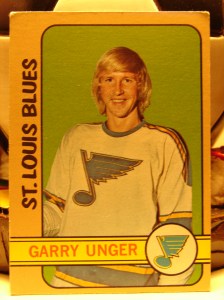
Yes. It was the long hair of Garry Unger that made him one of the coolest players in the NHL. The first NHL game I went to was at the Olympia on January 9, 1971. The Red Wings defeated the Buffalo Sabres, 3-2. Unger played for the Red Wings, and even though legend Gordie Howe was on the ice in his last season as a Red Wing, it was the long flowing hair of Unger that caught my attention. About a month later, Unger was traded to St. Louis with Wayne Connelly for Red Berenson and Tim Ecclestone. Not even a month in to following this team and they traded a favorite of mine. Unger went on to having a great career, playing over 1,100 NHL games and setting the iron man record of 914 consecutive games (later broken by Doug Jarvis). The 1972-73 Topps card still in my collection.
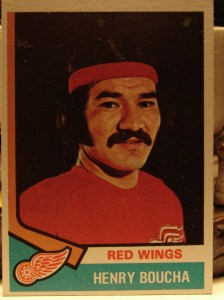
1972. The year I strapped on skates for the only season of little league hockey for me. That same season, the Red Wings dressed rookie Henry Boucha. His Topps 1973-74 rookie card shows a poised, clean-shaven, thick-haired young man. However he became a fan favorite sporting a headband instead of a helmet. He even made an appearance at the Plymouth Cultural Center, where I played, to sign autographs. I remember owning a headband, but not allowed to wear it in lieu of a helmet. A wise thing for a ten year old learning to play the game while at the same time learning to skate. This 1974-75 Topps card remains in my collection, depicting him more accurately than his rookie card had. He played two seasons for the Red Wings, in 143 games, with 33 goals and 26 assists, before being traded to the Minnesota North Stars for Danny Grant.
Making it look Mean:

I agree with Reid that the 1973-74 Phil Roberto card is a classic of all cards when it comes to the game’s aggressive nature. And if I remember correctly, the Billy Smith card from that season looks as if it was taken just after this fight, as he is putting him and his equipment back together.
I always thought this Cam Connor card from the O-Pee-Chee 1976-77 WHA set had an intimidating look. Connor, a career pugilist, racked up 904 penalty minutes in 274 games in the WHA, and additional 256 penalty minutes in 89 NHL games.

Keith Magnuson played his entire 589 NHL game career with the Chicago Blackhawks. And the defenseman was one of the feistiest players of his day. The look of his 1972-73 Topps card, with Magnuson in the penalty box, and photographed with a fisheye lens, was a clear guide of where to direct your gaze if you wanted to see Keith Magnuson at a hockey game.
The WHA:
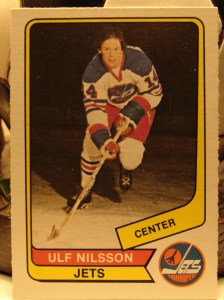
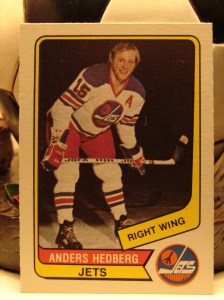
I loved the WHA. Though having not seen a game until the late 90’s when I found a DVD of the final Avco Cup trophy game, I still loved reading about the WHA in its section of The Hockey News. My dad subscribed to the hockey weekly, which had articles on every team in the NHL, a section for the WHA, and sections for the other minor-pro leagues and Canadian Juniors. The box score for every NHL and WHA game was published in them, Being from Metro Detroit, you’d think I would have been a fan of the Houston Aeros and the New England Whalers, for that is where Gordie Howe and his two sons, Marty and Mark, played together. And Bobby Hull being a former Blackhawk, I shouldn’t be rooting for the Winnipeg Jets. However, the duo who kept Hull in the limelight – Ulf Nilsson and Anders Hedberg – were favorites of mine. At the time, the great debate was which right winger was better – Hedberg or Guy Lafleur. Both were of the same age, and both were in the prime of their careers. From 1974-1978, Hedberg scored 236 goals, 222 assists, for 458 points in 286 games. Lafleur had 225 goals, 287 assists, for 512 points in 308 games during the same years. However, when Hedberg joined the New York Rangers after the WHA folded and the NHL absorbed four of its teams, Lafleur racked up more points than Hedberg in the three seasons from 1978-1981. But Lafleur was a part of the legendary Canadiens dynasty of the late 1970’s. Would he have had the same production on a team of lesser talent than the Winnipeg Jets of the WHA, or New York Rangers? It always made for a fun argument.
I had every one of the O-Pee-Chee WHA sets complete at one time. I’ve sold all but the 1976-77 set from which these two cards come from.
A good book about the WHA is Ed Willes’ The Rebel League: The Short and Unruly Life of the World Hockey Association (McClelland and Stewart, 2005)
The Goalies:

There was something about Rogie Vachon that drew me to putting him among my favorite goalies growing up. I had liked the LA Kings uniforms back then, and he became an all-star goalie on an average team. Where the Drydens and Cheevers and Parents and Espositos got all the accolades, Vachon stood on his head for the Kings back in the day. I like this 1974-75 Topps card which features Vachon in the Kings garb and the old-style goaltender equipment from the 1970’s.

Then, there were awesome goaltenders on horrible teams. Gilles Meloche was that guy. I, too, liked the Oakland Seals/California Golden Seals uniforms – each variation from season to season. And though the team was pretty much a given two points for any team they faced, Meloche made it a hard-earned two points. The 1973-74 Topps Card again shows the goaltender equipment of the 70’s in the Seals uniform, and the 1977-78 O-Pee-Chee card has him decked out in the Cleveland Barons red, where the Seals migrated to in 1976 before being merged with the Minnesota North Stars two years later.

By the mid-Seventies, I had lost my interest in the Red Wings. They never won games, were never in the playoffs, and they kept trading away my favorite players. When one of them – Marcel Dionne – was traded to the LA Kings, I started to claim them as my favorite team. However, there was no Internet or ESPN back then, and seeing a Kings game on Hockey Night in Canada was rare. With the expansion in 1974 adding the Kansas City Scouts (and Washington Capitals) to the league, the Scouts had me peeking in their direction. Former Red Wing legend, Sid Abel, was the general manager of the team, and brought over one of my favorite Wings, Guy Charron, and others. After two seasons, the team left Kansas City for Colorado, but not before drafting a young defenseman from the Toronto Marlboros. More on that later, however that move to Colorado and the players that were emerging there drew me. I was becoming a Colorado Rockies fan.
Doug Favell’s mask is the reason for this card’s presence. Favell had a career playing for the Flyers and the Maple Leafs before coming to Colorado in 1976 to finish his career.
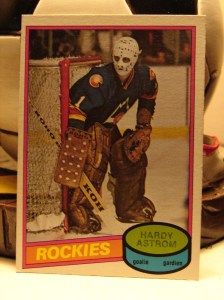
And one cannot talk about goaltenders, the Colorado Rockies, and the 1970’s without mentioning Hardy Astrom. This 1980-81 O-Pee-Chee card is the only one of the goalie that Don Cherry gained a lot of his material from. Cherry coached the Rockies in the 1979-80 season where he had Astrom between the pipes in 49 of them. But it wasn’t all bad for the Swedish goalie.
On Saturday, February 25, 1978, the Rangers were to play the Montreal Canadiens on Hockey Night in Canada. The Habs were on a record streak of 28 games without a loss. And the Rangers started the rookie Swede in goal against the league powerhouse. Astrom went on to stop 29 shots and the Rangers won 6-3, snapping the Candiens streak.
Cool:


There were a lot of cool cards during the years, but I chose these because they represented the Colorado Rockies, the team I was becoming a fan of, and because they were all action photos. It was shots like these that inspired me to shoot sports action photography. Posed photos are nice, but to capture humans practicing their humanity, whether it be skating on the ice and scoring a goal, making a save, kicking a ball downfield on a soccer pitch, fans creating plumes of smoke, or humans performing compassion in action, I find a sense of creativity and beauty of capturing those moments as they happen.
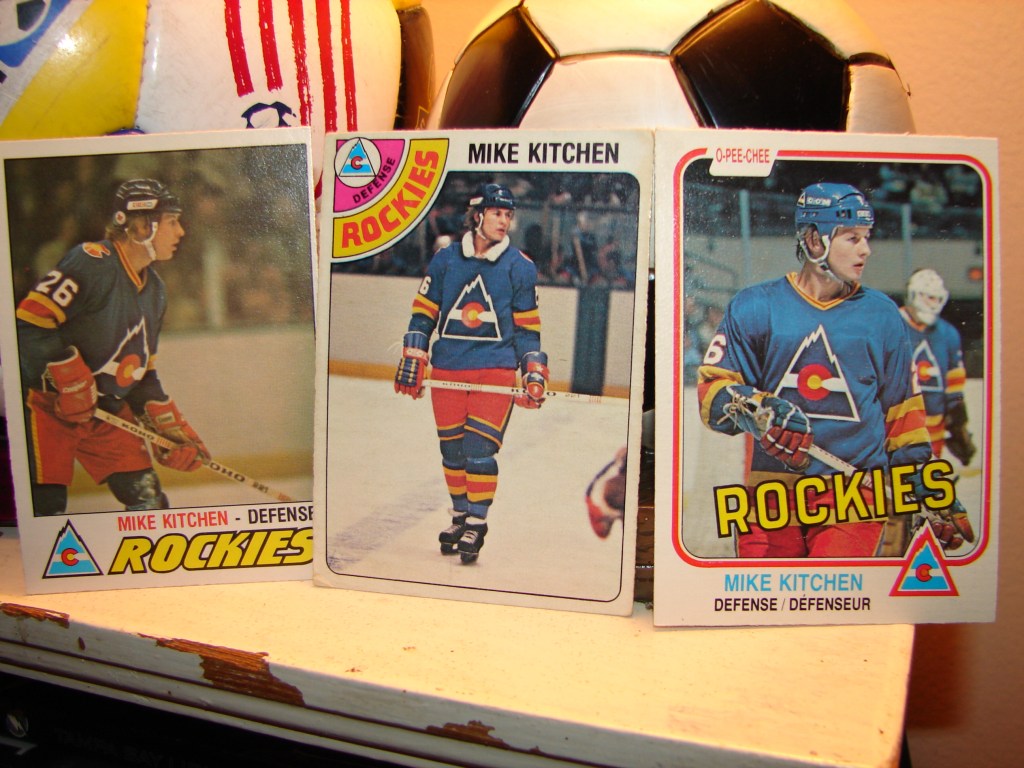
And, well, this is the ultimate cool. This was the guy who was drafted by the Kansas City Scouts, and began his career with the Colorado Rockies. I rooted for my namesake for the obvious reason – if he was on a Stanley Cup winning team, our name would be engraved on the Stanley Cup! It took almost 40 years, but as the Assistant Coach of the 2013 Chicago Blackhawks, (and again in 2015), the dream has been realized. Now I have to see the Stanley Cup with our names etched on it.
I got to see him play live, once, at Joe Louis Arena for the New Jersey Devils on October 8, 1983 in the Red Wings home opener. The Devils won, 6-3.

Airbrush:
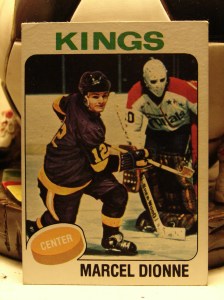
I no longer have what I considered the classic airbrush card, but this one will do. My first favorite player, Marcel Dionne, was traded from the Detroit Red Wings to the Los Angeles Kings in the summer of 1975. This 1975-76 Topps card shows him in the Kings purple jersey, however wearing number 12 – the number he wore as the Red Wings’ captain during the 1974-75 season. In LA, he took the #16 jersey.
But the airbrush I remember was from the 1974-75 Topps Jacques Lemaire card. Lemaire played his entire twelve-year career as a member of the Montreal Canadiens. But for some reason the O-Pee-Chee/Topps company airbrushed him into a Buffalo Sabres uniform and displayed him as a player on the Buffalo Sabres.
The 80’s:
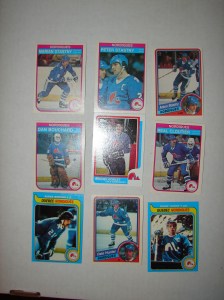
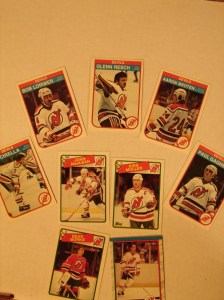
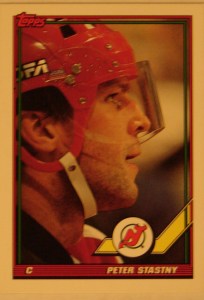
The 1980’s hockey to me meant the Quebec Nordiques and the New Jersey Devils. I became a fan of the Devils after having followed the Rockies and their move to New Jersey. They developed young talent due to high draft picks from finishing low in the league. It was the Nordiques I found myself rooting for most often in the playoffs. I thought Peter Stastny was an amazing player, and human being, defecting from Czechoslovakia with his brother, Anton, in 1980. He played the decade with the Nordiques, then was traded and played four seasons with the Devils, ending his career with a season in St. Louis.
Error Cards:
I liked the Steve Larmer/Steve Ludzik rookie errors from the 1984-85 Topps/O-Pee-Chee sets, like Reid. So I think I’ll take this moment to point out the only error I uncovered in Reid’s book.
On Page 94, Reid begins Chapter Five: Cool Cards with the 1977-78 Pat Hickey card. The content of the chapter talks about Hickey being traded from the Rangers before Hickey was to appear on the “Hockey Sock Rock” video, sung by a number of the Rangers’ players. On Page 95, Reid writes, “But Hickey wasn’t in the video. It turns out he was traded to the Los Angeles Kings before Espo, JD, Dave Maloney and Ron Duguay made the famous video.” At the bottom of the page, he quotes Hickey. “We did this film for an ad and then we got on a plane and went to Los Angeles and that’s when I was traded for [Barry] Beck.”
The Colorado Rockies fan in me cringed. No. Hickey was traded to Colorado for Barry Beck. Beck was the first round draft choice (#2 overall) of the Rockies in 1977. In his third season with the Rockies, Beck went to the Rangers for Hickey, Lucien Deblois, and Dean Turner. Hickey never played for the Kings.
The other reason I remember that trade is because of the third wheel in the deal. Dean Turner was a player trying to break into the NHL. From Dearborn, Michigan, he was the son of a local news personality – Marilyn Turner.
Rookies:

The first year I started buying cards at the store, tearing open the packs to get at the cards to complete the 132 card set was the year of the Ken Dryden rookie card. The cerebral Dryden came out of Cornell University, played six games at the end of the 1970-71 season, then surprised the Boston Bruins in the first round in seven games. He then led the Habs past the Minnesota North Stars in six games in Round Two; then another seven game battle against the Blackhawks to win the Conn Smythe Award for being the MVP of the playoffs. Dryden went on to be the #1 goaltender for the Habs throughout the 1970’s, with the exception of the 1973-74 season where he went to work as a law clerk for a Toronto law firm while in a contract dispute with the Canadiens.
His books, The Game: A Reflective and Thought Provoking Look at a Life in Hockey (Macmillan Company of Canada, 1983) and Home Game: Hockey and Life in Canada (McClelland and Stewart, 1990) are classics and good reads for the hockey aficionado.
Hall of Famers:
Reid writes about the 1971-72 O-Pee-Chee (and Topps) card of Phil Esposito wearing slacks. When I read that, I recalled the card, and that his teammate, Ken Hodge was also immortalized on a hockey card in slacks.
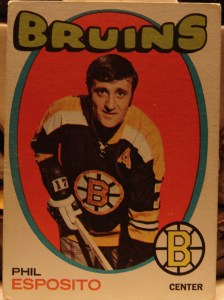
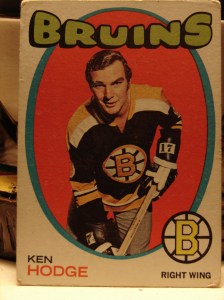
O-Pee-Chee/Topps must have liked the look, because they repeated it in the 1972-73 set.

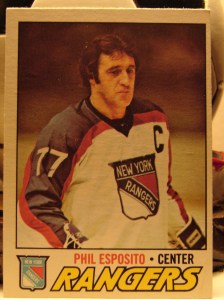
Reid’s chapter on Espo is a reminder of the character he was. Individual characters seem to be lost in today’s team sports, unfortunately. This 1977-78 O-Pee-Chee card shows him in the New York Rangers look of the late 70’s, a jersey I thought was cool. It also happens to be an uncorrected error card, as its stats incorrectly show Espo scoring 78 goals in 1972-73 (he scored 55 that season).
When it comes to Hall of Famers, though, my favorite all-time player is Patrick Roy. He emerged much like Ken Dryden did, winning the Conn Smythe in his first season as the Habs won the 1986 Stanley Cup. His idiosyncrasies and confidence made him a character as well as the NHL’s greatest goalie.
In 2001-02, Topps issued a parallel set, which I tried to collect because they were formatted like the 1971-72 set – the set that began it for me. I haven’t completed that set.
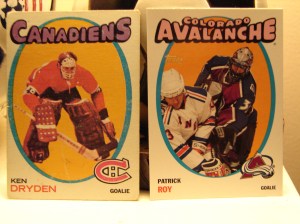 Reid’s book obviously took me down memory lane, and into the boxes and 9-pockets of cards I still have. If you collected hockey cards and followed the sport back in the 70’s and 80’s, you’ll find enjoyment in this book.
I stopped collecting hockey cards shortly after the market flooded with companies like Upper Deck, Score, Pro Set and Fleer entering the fray. I also left hockey behind as well. The game has changed too much, not necessarily for the better. Instead, I’ve rediscovered my appreciation for “the beautiful game.” These are the only cards I collect now – Major League Soccer cards. It’s very simple, a single set each year, first released by Upper Deck, then within the last couple seasons, by Topps. It’s just like back when only O-Pee-Chee/Topps existed in the hockey card world.



June 29, 2014
Detroit City FC 4, Indiana Fire 0
DCFC Jeff Adkins (Latif Alashe) 31′
DCFC Jeff Adkins 57′
DCFC Cyrus Saydee (Oliver Harris) 69′
DCFC Shawn Lawson (Lachlan Savage) 87′
Attendance: 2,858
Nine days earlier, this Indiana Fire team handed Le Rouge its first regular season defeat in almost two years. Now they’re on our pitch. Payback’s a bitch.
It was the first steamy summer day for shorts, so I was able to debut the socks my niece Anna got me for Christmas. She’s attending Central Michigan University.

Pre-Game



Action


















 DoHaeng Michael Kitchen